
Key Takeaways
- Series A for Zya: Astanor led a £11.5m ($15m) round, AgFunder News reported on November 16, 2026. StartupMag reports £11.3m for the same round.
- Convero enzyme: Zya claims it converts around 30% of sucrose into prebiotic fiber after food is eaten.
- Human study: neither outlet reports one. The round will fund human studies, regulatory work and partnerships.
- Sugar reduction without reformulation: AgFunder says the enzyme lets firms improve the nutritional profile of foods without reformulating them.
AgFunder News reported on November 16, 2026 that Zya, a UK foodtech startup, raised £11.5m ($15m) in the Zya Series A led by Astanor, with Ahren Innovation Capital, Red Bull Ventures, Zubi Capital, Phase Change and Meach Cove Capital. The round will fund human studies, regulatory work and commercial partnerships for Zya's enzyme, Convero, which the company says turns sugar into fiber after food is eaten.
Zya's timing: eight calendar years from founding, a launch target up to about 13 months after the round was reported.
Oxford University biochemists Joshua Sauer and Niels Leckie founded Zya in 2018, according to AgFunder News. The Series A came eight calendar years after the 2018 founding and four calendar years after Astanor's 2022 seed funding. The first US product launch is targeted by the end of 2027, which is at most 410 days (about 13 months) after the round was reported on November 16, 2026. Both outlets print these dates. Neither calculates the intervals.
Series A amount for Zya: AgFunder reports £11.5m, StartupMag £11.3m
AgFunder News reports £11.5m ($15m) for the round, and StartupMag reports £11.3m. This story uses AgFunder's figure. A Series A is a venture round that usually follows a seed round. The two reports differ by £0.2m, and neither explains the difference. Both name the same co-investors beside Astanor, the lead: Ahren Innovation Capital, Red Bull Ventures, Zubi Capital, Phase Change and Meach Cove Capital. AgFunder says Astanor provided Zya's seed funding in 2022, and StartupMag says Astanor also took part in that seed financing.
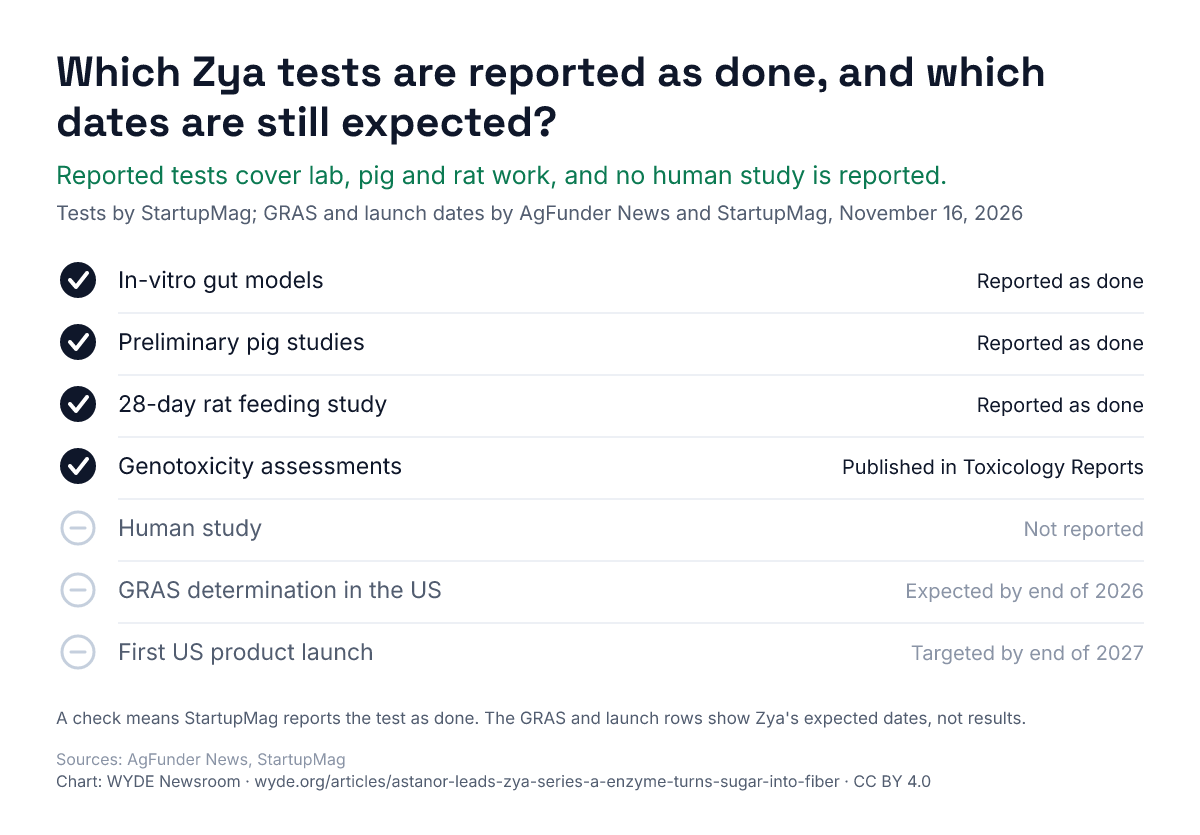
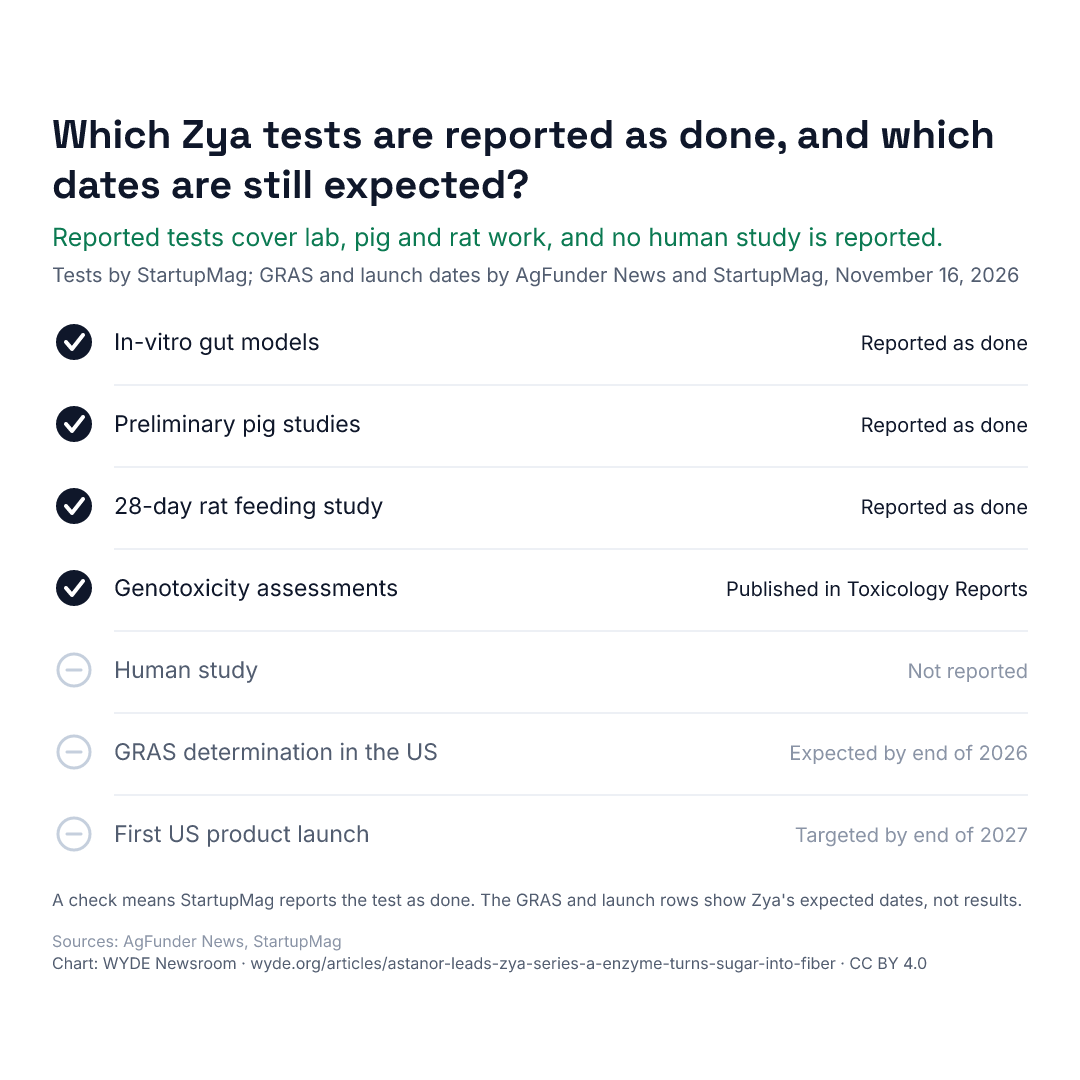
Which Zya tests are reported so far, and which are still open
StartupMag reports that Zya has shown functionality in in-vitro gut models, which are lab tests rather than tests in people, and in preliminary pig studies. It also reports an independent toxicology program that included a 28-day rat feeding study and genotoxicity assessments (tests for damage to DNA), published in Toxicology Reports. Neither outlet reports a human study. Both outlets say the round will fund human studies.
Zya expects to complete a self-affirmed GRAS determination in the US by the end of 2026, followed by a formal GRAS submission to the FDA. GRAS stands for Generally Recognized as Safe, and a self-affirmed determination is a company's own finding that an ingredient meets that standard before any formal submission. Zya targets its first US product launch by the end of 2027, with first products going to US food manufacturers.
Use this chart
Free to republish under CC BY 4.0: credit WYDE Newsroom and link to this article. All WYDE charts.
Credit line
Embed code
Download the chart (PNG, 1200 by 835) · Square version for social posts (1080 by 1080)
The 30% claim and the chocolate bar label
Zya claims its enzyme converts around 30% of sucrose in foods into fructooligosaccharides, or FOS. Sucrose is table sugar. AgFunder describes FOS as a class of prebiotic fibers that resist digestion in the small intestine and are fermented by bacteria in the colon. Joshua Sauer, Zya's CEO, explained that the enzyme "attaches the fructose part of the sugar onto another sucrose molecule" as it builds the fiber.
Both outlets place the conversion after food is eaten. AgFunder says the enzyme can stay inactive in low-moisture products such as chocolate, cereal bars, biscuits and confectionery until it reaches the digestive tract. It also says a chocolate bar with Convero would contain the same sugar when sold, so manufacturers could not lower the declared sugar content on the Nutrition Facts panel. Text beneath the panel would instead report total sugar and dietary fiber after eating. Proposed front-of-pack wording (the label on the front of the package) might say the enzyme converts 30% of sugar into fiber after eating. That wording does not change the declared sugar.
What the round still has to show
The round funds the work still open: human studies, regulatory work and partnerships. Sauer said several multinationals have completed feasibility projects spanning chocolate, baked goods, bars and confectionery. "The larger companies have demonstrably shown the most interest," said Sauer. Neither report says a co-development agreement (a deal to develop a product together) is signed, and AgFunder says several projects are progressing toward one.
Three milestones would test the claims: a human study, the GRAS determination due by the end of 2026, and the first US product launch by the end of 2027. Neither report includes results from any of them. Until those results are published, the 30% figure remains Zya's own claim.
People Also Ask
Who led Zya's Series A?
Astanor led Zya's Series A, which AgFunder News reported on November 16, 2026. AgFunder says Astanor also provided Zya's seed funding in 2022, and StartupMag says Astanor took part in that seed financing.
How much did Zya raise in its Series A?
AgFunder News reports that Zya raised £11.5m ($15m) in its Series A. StartupMag reports £11.3m for the same round, and this story uses AgFunder's figure.
What does Zya's enzyme do?
Zya says its enzyme, Convero, converts around 30% of sucrose in foods into prebiotic fiber after food is eaten. AgFunder News describes that fiber as fructooligosaccharides, or FOS, which resist digestion in the small intestine.
Sources: AgFunder News, StartupMag.