

Key Takeaways
- Charitable deduction without itemizing: up to $1,000 for single filers and $2,000 for married couples filing jointly, for cash gifts made in 2026.
- Standard deduction filers: the deduction is for taxpayers who do not itemize, and it begins with tax year 2026.
- Which gifts count: only direct cash contributions to a qualified 501(c)(3) public charity, and amounts above the cap cannot be carried forward.
- At 22%, a single filer's $1,000 gift costs $780 after tax and a joint filer's $2,000 gift costs $1,560.
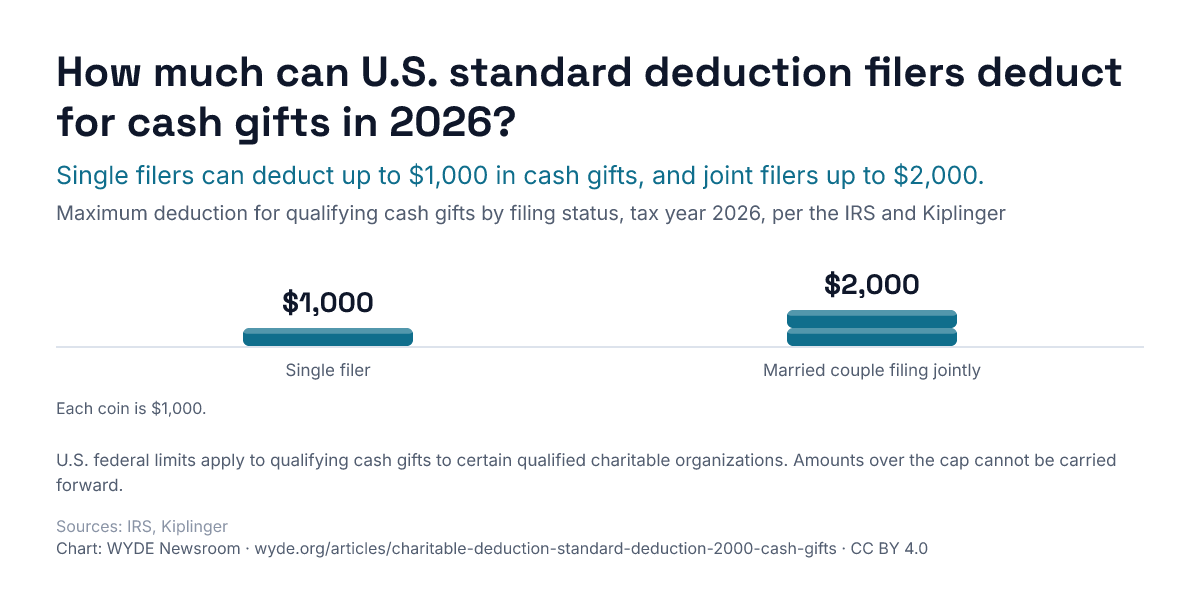
On November 10, 2026, the Internal Revenue Service reminded standard deduction filers that a permanent charitable deduction lets them deduct up to $1,000 of qualifying cash gifts made in 2026 to certain charities. Married couples filing jointly may deduct up to $2,000. Those non-itemizers generally claim the standard deduction.
Charitable deduction limits for 2026: $1,000 single, $2,000 joint
The IRS says the Working Families Tax Cuts provides a permanent deduction for charitable contributions made in 2026, and that the deduction begins for returns filed next year. Kiplinger refers to the same change as the 2025 Trump tax bill. Under the new law, individuals who do not itemize may deduct up to $1,000 of qualifying cash contributions, or $2,000 for married taxpayers filing jointly, to certain qualified charitable organizations.
Use this chart
Free to republish under CC BY 4.0: credit WYDE Newsroom and link to this article. All WYDE charts.
Credit line
Embed code
Download the chart (PNG, 1200 by 602) · Square version for social posts (1080 by 1080)
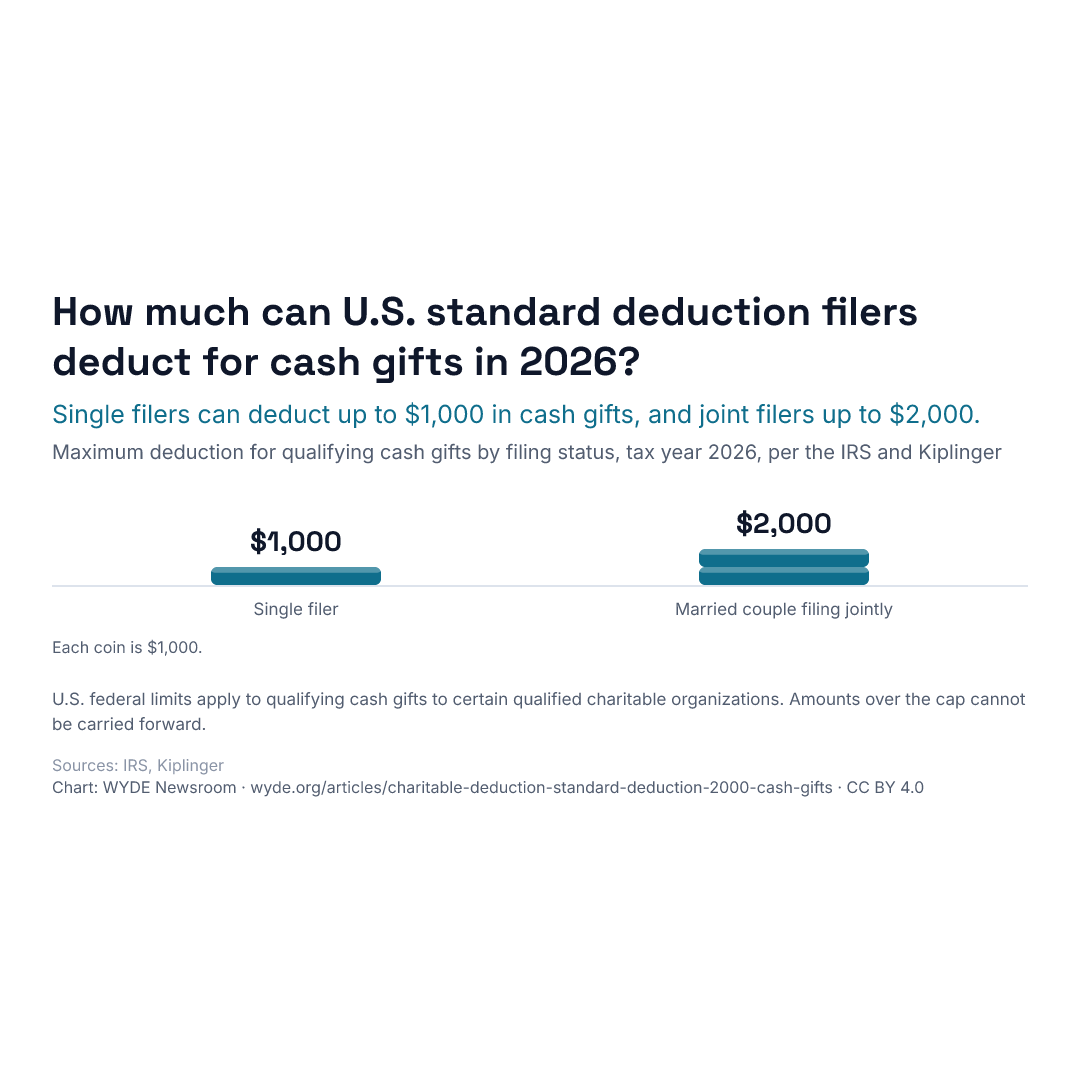
The joint limit is twice the single limit, $2,000 compared with $1,000. Kiplinger calls these amounts the ceiling for eligible cash giving. At the 22% rate, a single filer's $1,000 gift costs $780 after the $220 saving, and a joint filer's $2,000 gift costs $1,560 after the $440 saving.
Kiplinger reports that roughly 90% of U.S. households claim the 2026 standard deduction rather than itemizing. It says the provision expands tax savings to an estimated 144 million taxpayers, according to data from Empower. It also says the break expands financial incentives for lower- and middle-income households, the groups that historically donate the highest percentage of their income, according to industry reports.
Which gifts count toward the charitable deduction for non-itemizers
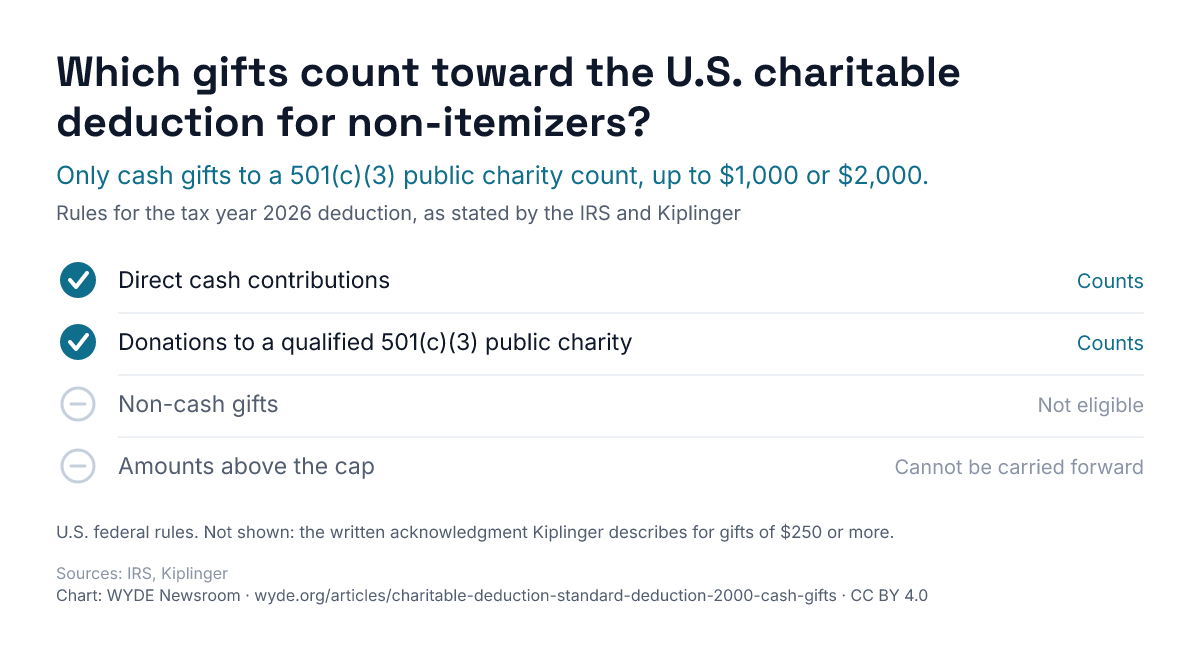
Direct cash contributions are the only gifts Kiplinger says are eligible, including payments made by check, credit card, debit card, or electronic transfer, up to the $1,000 or $2,000 cap. Non-cash gifts do not count under that rule.
Donations to a qualified 501(c)(3) public charity count, according to Kiplinger. A 501(c)(3) public charity is a tax-exempt charity under section 501(c)(3) of the tax code. The IRS describes eligible recipients as certain qualified charitable organizations.
Use this chart
Free to republish under CC BY 4.0: credit WYDE Newsroom and link to this article. All WYDE charts.
Credit line
Embed code
Download the chart (PNG, 1200 by 649) · Square version for social posts (1080 by 1080)
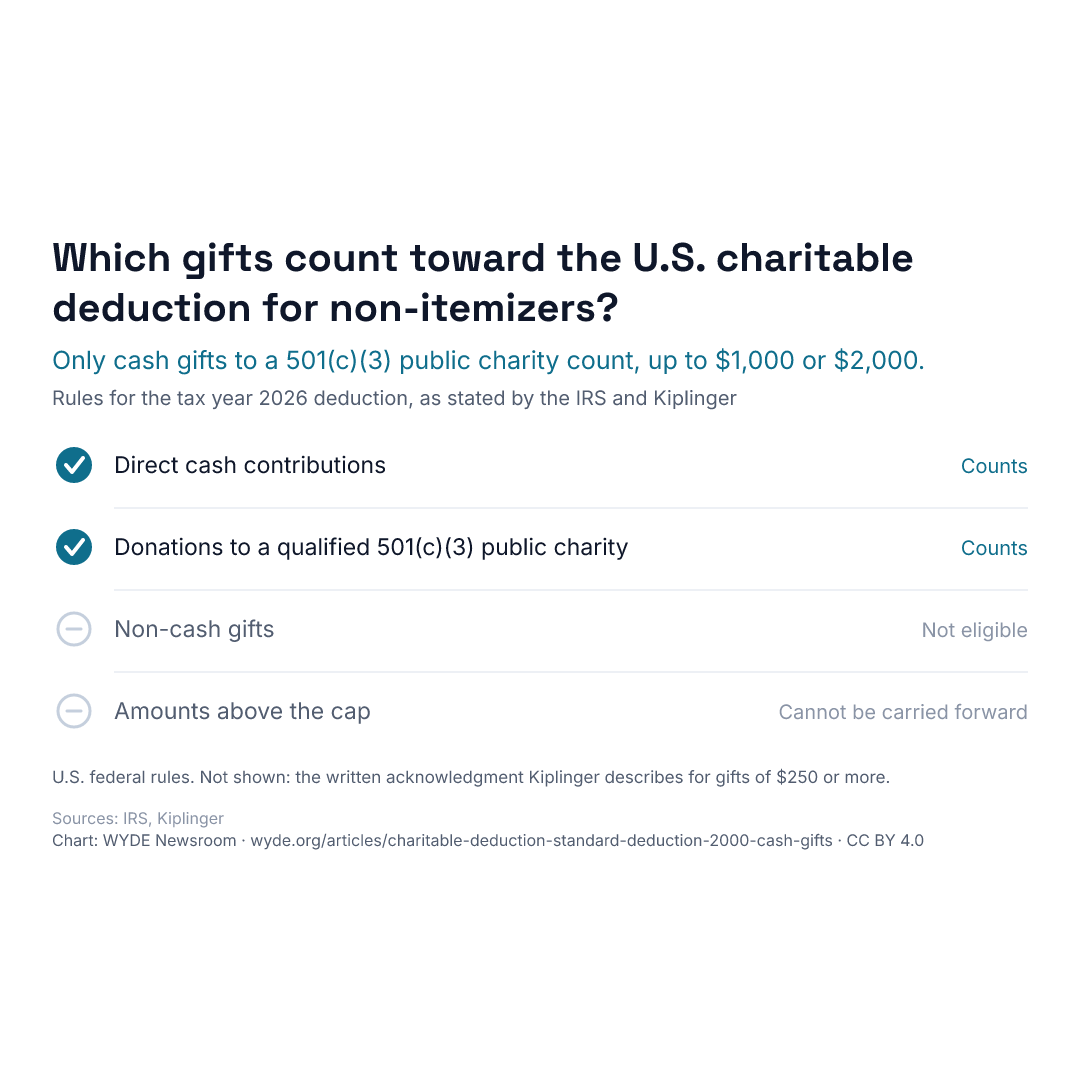
Amounts above the cap cannot be carried forward to future tax years, which Kiplinger calls a key difference from traditional itemized contributions.
Tax savings and records to keep for the 2027 filing season
Kiplinger's example is a joint-filing couple with an adjusted gross income of $200,000 who claims the $2,000 maximum in the 22% marginal federal tax bracket. Kiplinger says those in the 22% to 24% brackets could save between $220 and $480 on federal income taxes.
For gifts of $250 or more, Kiplinger says the taxpayer must get a formal written acknowledgment from the qualifying charity before filing. That receipt is called a contemporaneous written acknowledgment, or CWA. It must state whether the taxpayer received any goods or services in return and give a good-faith estimate of their value.
The IRS encourages taxpayers to understand the new rules and keep records of qualifying contributions made during 2026 as the 2027 filing season approaches. IRS Chief Executive Officer Frank J. Bisignano said: "Making permanent the provision that allows taxpayers to take a deduction whether they itemize or not will encourage giving now and in the future for the benefit of taxpayers and the exempt organizations they support." For WYDE's earlier story on the 2026 charitable deduction, read New 2026 Charitable Deduction Floors Could Cut Giving by $81 Billion a Decade.
People Also Ask
Can I deduct charitable gifts if I take the standard deduction?
Yes, for tax year 2026. The IRS says individuals who do not itemize may deduct up to $1,000 of qualifying cash contributions made to certain qualified charitable organizations, or $2,000 for married taxpayers filing jointly.
What is the charitable deduction limit for married couples filing jointly in 2026?
The limit is $2,000 for married taxpayers filing jointly who do not itemize, according to the IRS. That is twice the $1,000 limit for single filers, which Kiplinger also reports.
Do non-cash gifts count toward the charitable deduction for non-itemizers?
No. Kiplinger says only direct cash contributions are eligible, up to the $1,000 or $2,000 cap, so non-cash gifts do not count under that rule.
Can cash gifts above the $1,000 or $2,000 cap be carried forward?
No. Kiplinger says cash giving above the $1,000 single or $2,000 joint ceiling cannot be carried forward to future tax years.