

Key Takeaways
- ChatGPT Wallet, introduced by OpenAI, lets agents in ChatGPT Work, Codex and dots complete purchases with user approval and existing card protections.
- ChatGPT Wallet works with American Express, Mastercard and Visa cards, and cardholders keep their existing card rewards, CNBC reported.
- ChatGPT Wallet is first available to U.S. Pro subscribers over 18, out of more than 1.2 billion weekly ChatGPT users and nearly 100 million paying users.
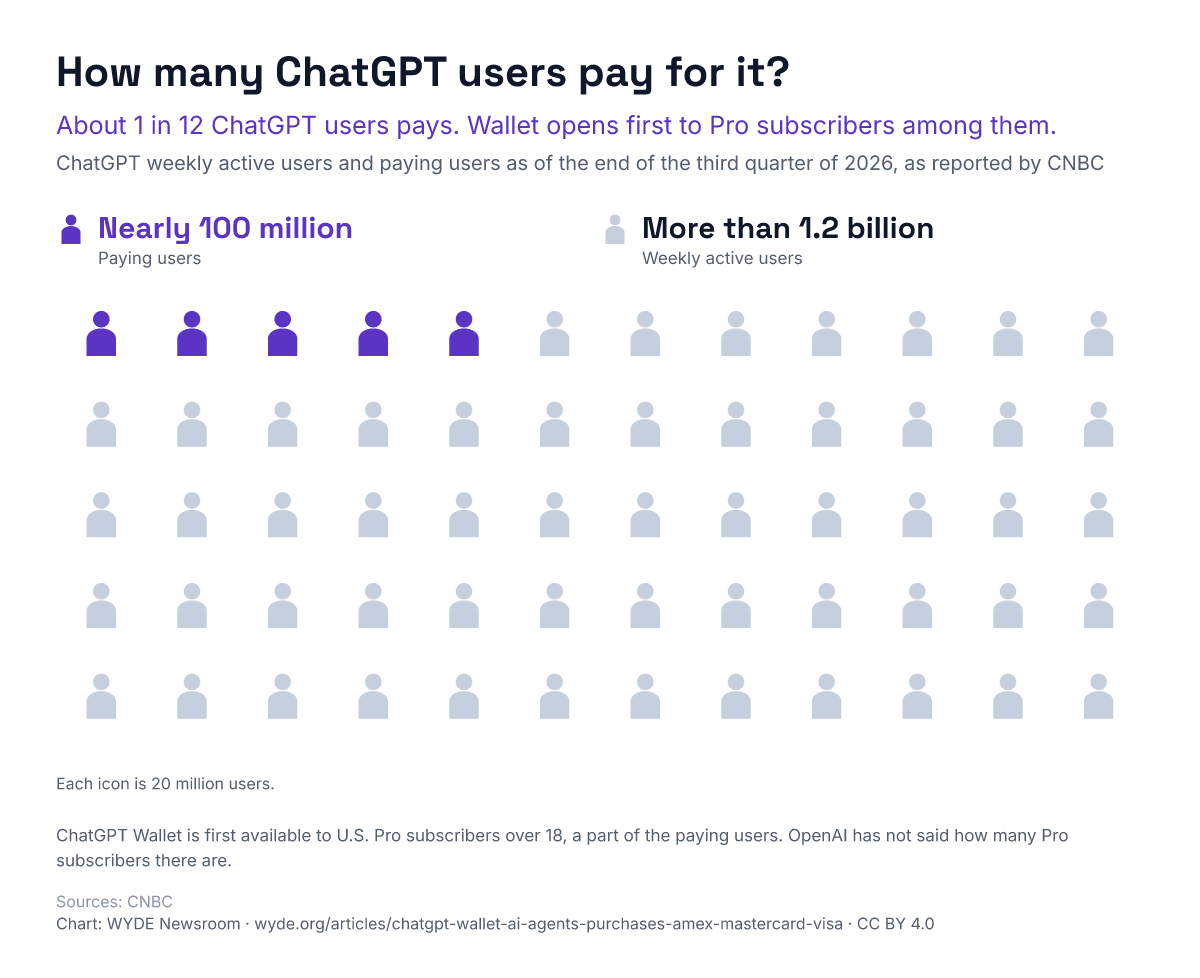
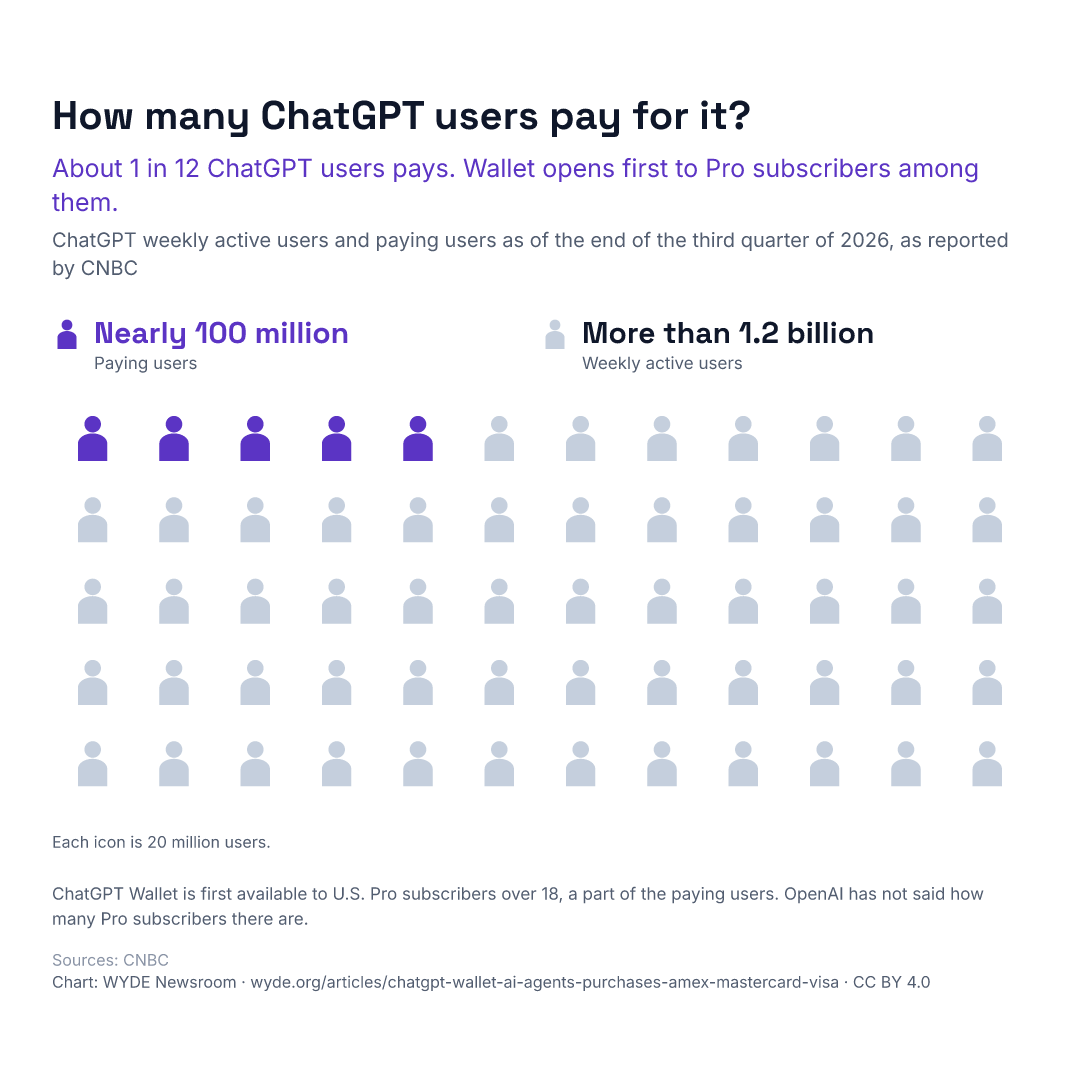
- About 1 in 12 weekly ChatGPT users pays, so the first ChatGPT Wallet users are a small part of the ChatGPT audience.
OpenAI introduced ChatGPT Wallet, a way for AI agents in ChatGPT Work, Codex and dots to complete purchases with user approval and existing card protections, according to the OpenAI announcement. CNBC reported on November 13, 2026, that ChatGPT Wallet works with American Express, Mastercard and Visa, and starts with U.S. Pro subscribers over 18.
An AI agent is software that carries out a task for a person, such as finding a product and checking out, instead of only answering a question. OpenAI described ChatGPT Wallet as part of building "trusted agentic payments with networks, banks, and businesses." Agentic commerce is the industry term for purchases that an agent completes for a shopper.
How ChatGPT Wallet works with American Express, Mastercard and Visa
Under ChatGPT Wallet, the shopper reviews and approves each purchase the agent proposes. American Express said ChatGPT Wallet is its first American Express Agentic Commerce Experiences integration, and that eligible Card Members can use their Amex Card while reviewing and approving each purchase. CNBC reported that cardholders of all three networks keep their existing credit card rewards.
Sherri Haymond, EVP and global head of digital commercialization at Mastercard, said in the OpenAI announcement: "An agent making a purchase should strengthen, not bypass, the trust built into payments." Visa said in the same announcement that it would bring its infrastructure to the experience, helping connect user-approved purchases with the systems businesses already use.
The rollout is narrow on purpose. CNBC reported that ChatGPT has more than 1.2 billion weekly active users and nearly 100 million paying users as of the end of the third quarter. That is about 12 weekly users for every paying user, and ChatGPT Wallet opens first to one group of paying users, the U.S. Pro subscribers over 18. OpenAI has not said how many Pro subscribers there are.
Use this chart
Free to republish under CC BY 4.0: credit WYDE Newsroom and link to this article. All WYDE charts.
Credit line
Embed code
Download the chart (PNG, 1200 by 978) · Square version for social posts (1080 by 1080)
Luke Gebb, executive vice president and global head of innovation at American Express, called the limited rollout the right approach to make sure things are working. "It just makes sense to watch it, start it in a contained environment, and then keep rolling from there," Gebb told CNBC. He said OpenAI can decide to "turn up the volume" on ChatGPT Wallet when it wants to.
Why ChatGPT Wallet is aimed at merchants and card networks first
Chaya Nayak, who leads product for monetization and payments at OpenAI, told CNBC the first audience is the payments industry rather than shoppers. "Our goal here is to really focus on merchants and our network partners and start building out a really great foundation that's safe and easy to use," Nayak said. She added that it will take time for the ecosystem to build the infrastructure to make the experience seamless across merchant sites.
The demand for agent shopping is still uneven. TechCrunch reported that DoorDash and Uber have so far reported low numbers of orders placed by AI agents, while Meta's Muse, which has over 10 million users, has seen AI-assisted shopping become a top activity on its app. WYDE has covered the same shift in restaurants, where Square connected ordering to ChatGPT and Claude, and in OpenAI's DevDay 2026 agent tools.
For the card networks, ChatGPT Wallet is a test of whether purchases made by software can carry the same protections as purchases made by a person. All three networks framed their part around trust and user approval. For OpenAI, the 1.2 billion weekly users are the reach that Gebb said it could open up later, once the first group of Pro subscribers shows the system works.
People Also Ask
What is ChatGPT Wallet?
ChatGPT Wallet is an OpenAI feature that lets AI agents in ChatGPT Work, Codex and dots complete purchases for a user. The user approves each purchase, and existing card protections apply, according to OpenAI.
Who can use ChatGPT Wallet?
ChatGPT Wallet is first available to OpenAI's Pro subscribers in the U.S. who are over 18, CNBC reported. American Express said the limited rollout is intentional and that the feature would reach more Card Members over time.
Which cards work with ChatGPT Wallet?
ChatGPT Wallet works with American Express, Mastercard and Visa, according to CNBC. Cardholders keep their existing credit card rewards when an agent buys through ChatGPT Wallet.
How many people use ChatGPT?
ChatGPT has more than 1.2 billion weekly active users and nearly 100 million paying users as of the end of the third quarter of 2026, CNBC reported. That is about 1 in 12 weekly ChatGPT users paying.
Sources: OpenAI, CNBC, TechCrunch.