

Key Takeaways
- ARTEX AI hacking tool: the Federal Bureau of Investigation (FBI) warned in a FLASH advisory (an FBI alert) released Friday that threat actors were using the open-source framework to automate attacks, and that some intrusions reached privileged access in under three hours.
- ARTEX attack speed: the advisory said some intrusions progressed from initial targeting to privileged access in under three hours.
- ARTEX targets: multiple threat actors had used the framework since at least August 2026 across financial, government, technology, defense, healthcare and other sectors.
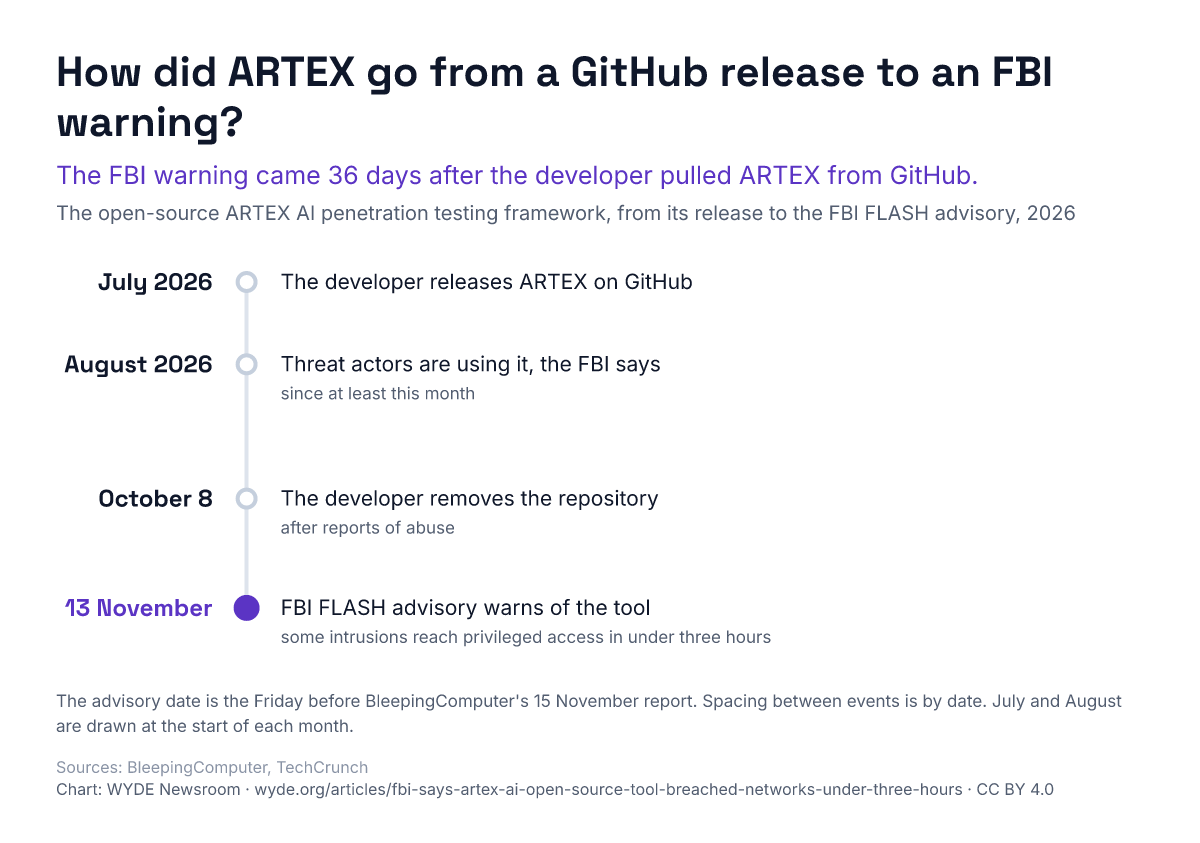
- ARTEX timeline: the original developer removed the repository on October 8, and the FBI advisory came 36 days later, counted to the Friday before BleepingComputer's 15 November report.
The Federal Bureau of Investigation (FBI) warned in a FLASH advisory released on Friday that hackers were using the open-source ARTEX AI hacking tool to automate attacks, and that some intrusions reached privileged access in under three hours.
BleepingComputer described ARTEX as an AI-powered penetration testing framework (a toolkit that simulates attacks to find weak spots) that hackers are using against organizations worldwide. Threat actors are the people or groups behind cyberattacks.
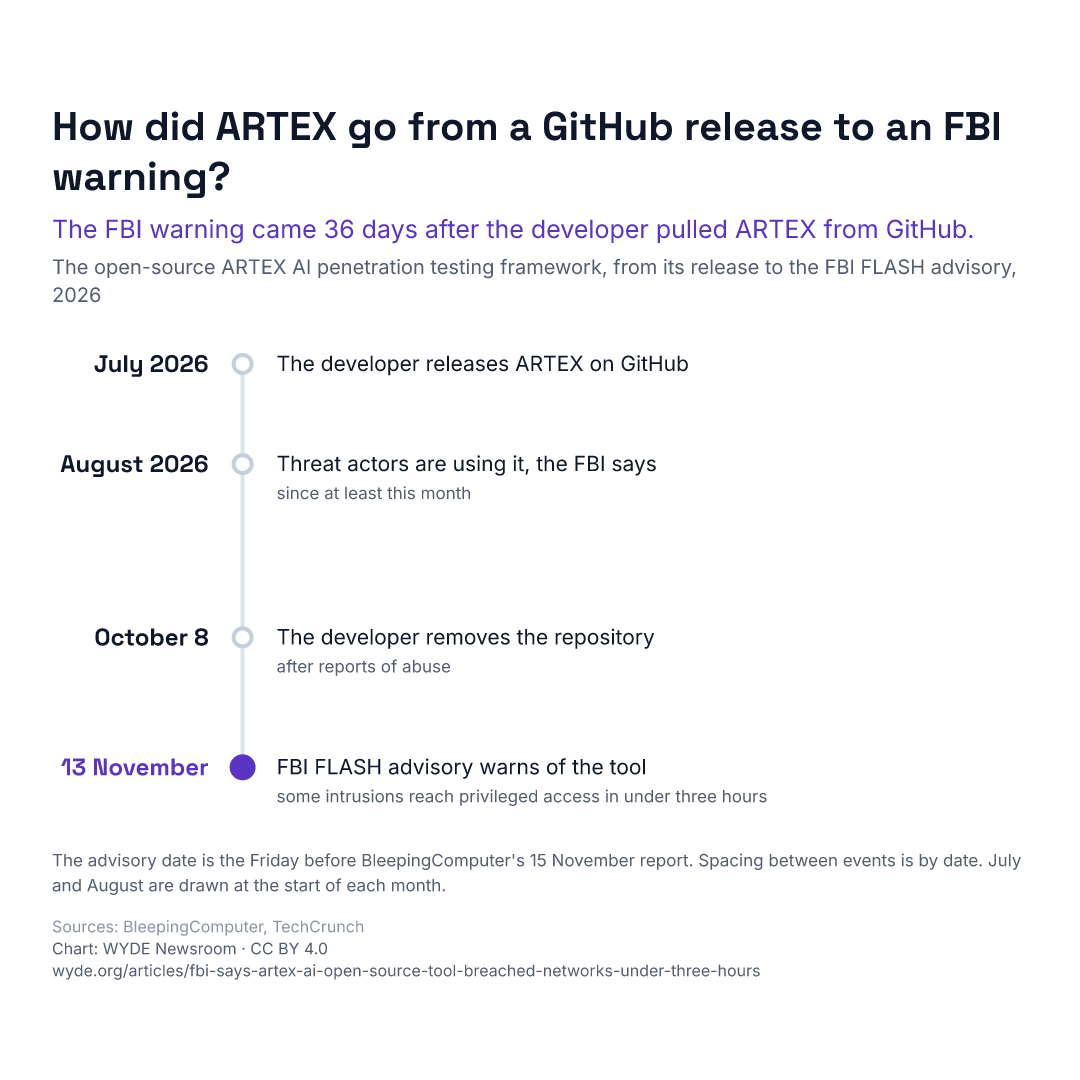
ARTEX timeline from its July 2026 release to the FBI warning
The original developer released ARTEX on GitHub in July 2026. The developer removed the repository, where the project's code is stored, on October 8, after reports emerged that threat actors were abusing the framework. The FBI said threat actors had weaponized the framework since at least August 2026, which is before that removal. BleepingComputer, reporting on 15 November, said the FLASH advisory was released on Friday. Counted to Friday, 13 November (the Friday before BleepingComputer's 15 November report), the advisory came 36 days after the removal on October 8.
Use this chart
Free to republish under CC BY 4.0: credit WYDE Newsroom and link to this article. All WYDE charts.
Credit line
Embed code
Download the chart (PNG, 1200 by 843) · Square version for social posts (1080 by 1080)
BleepingComputer published its report on 15 November, and TechCrunch published its report on 16 November.
How fast ARTEX intrusions reach privileged access
The speed figure comes from the advisory's own wording. BleepingComputer quoted the FBI advisory as saying that "ARTEX significantly reduces the time required to chain attack techniques, with some intrusions progressing from initial targeting to privileged access in under three hours". That sentence is where the headline figure comes from.
Privileged access means an account or session with administrator-level control over a system.
The qualifier matters. The advisory described some intrusions, not all of them, so the three-hour figure covers a subset of attacks rather than a standard time.
BleepingComputer reported that the FBI said threat actors targeted organizations across the financial, government, technology, defense, healthcare and other sectors. TechCrunch reported that the FBI said the tool was used in cyberattacks targeting a U.S. IT giant and the South Korean financial industry.
BleepingComputer also reported that the FBI warning described attacks against organizations worldwide, including a recent ConnectWise supply-chain breach that compromised Microsoft 365 customer environments. A supply-chain breach works through a vendor, so the attack reaches the vendor's customers.
What the three-hour window means for defenders
The figure measures the path to privileged access, not the full length of an intrusion. A defender who detects an intrusion only after privileged access is granted has less room to respond than one who detects it earlier.
The two stages the advisory names suggest a simple test for security teams: whether activity is caught during initial targeting or only after privileged access. The advisory says ARTEX significantly reduces the time attackers need to link attack steps together. The three-hour figure shows how quickly the window can close in some intrusions. It does not show how many intrusions moved that fast, so it should not be read as a standard for every sector or every attack.
Reports of abuse came before the developer removed the repository on October 8.
People Also Ask
What is the ARTEX AI hacking tool?
ARTEX is an open-source AI penetration-testing framework. The FBI said multiple threat actors had weaponized ARTEX since at least August 2026 to automate cyberattacks against organizations worldwide. Some intrusions reached privileged access in under three hours.
Did the FBI warn about ARTEX attacks?
Yes. The Federal Bureau of Investigation released a FLASH advisory on Friday, warning that hackers were using the ARTEX AI hacking tool to automate attacks, and that some intrusions reached privileged access in under three hours. The advisory said ARTEX significantly reduces the time required to chain attack techniques.
How fast can ARTEX intrusions reach privileged access?
The FBI advisory said some ARTEX intrusions progressed from initial targeting to privileged access in under three hours. The advisory described some intrusions, not all of them, so the three-hour figure does not describe every ARTEX attack.
When did the developer remove ARTEX from GitHub?
The developer who released ARTEX on GitHub in July 2026 removed the repository on October 8, after reports emerged that threat actors were abusing the framework.
Sources: BleepingComputer, TechCrunch.