

Key Takeaways
- SpaceX 1 million satellites: the Federal Communications Commission (FCC) on November 25, 2026, authorized SpaceX's Starmind system of up to 1 million orbital compute satellites, and deferred only its request to waive a satellite disposal rule.
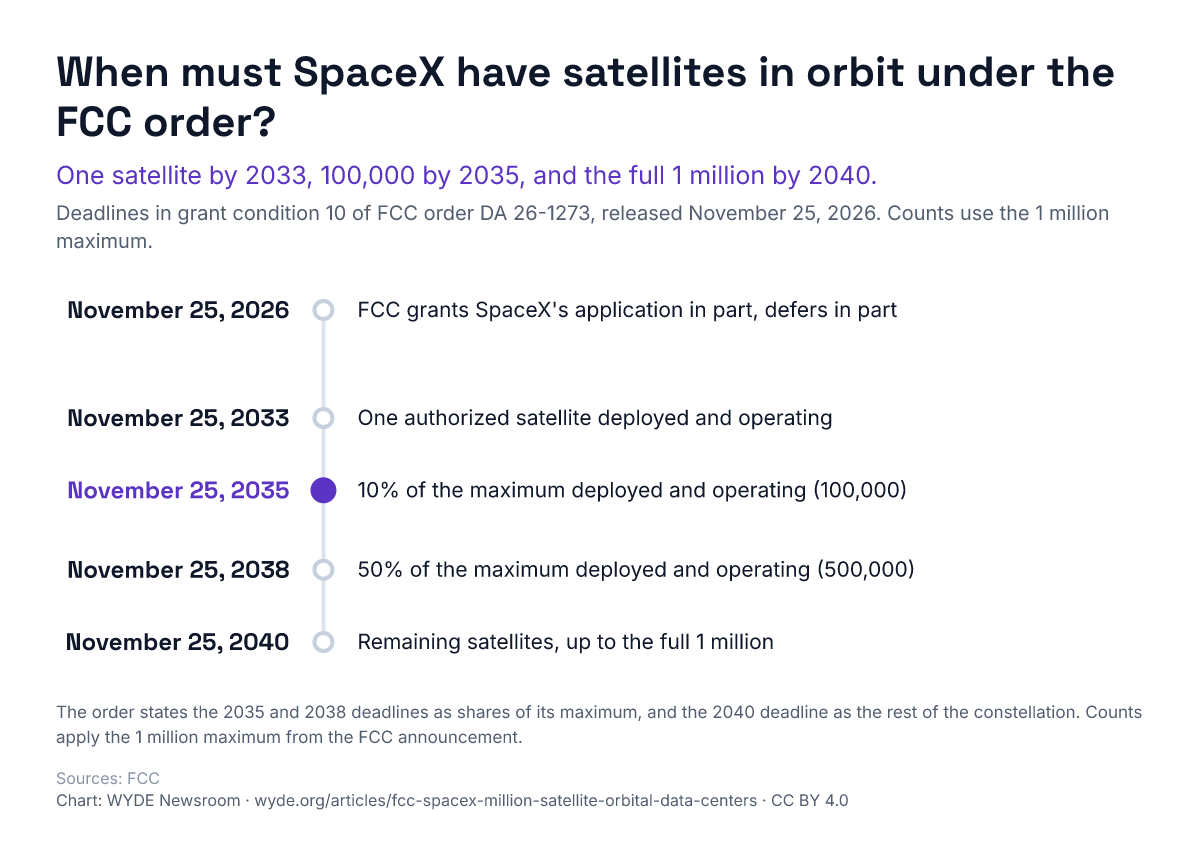
- FCC milestones: one satellite by November 25, 2033, 100,000 by November 25, 2035, 500,000 by November 25, 2038, and the full 1 million by November 25, 2040.
- 2035 and 2038 are shares of the maximum (10% and 50%), and 2040 is the rest of the constellation (order condition 10(d): the remaining space stations necessary to complete its authorized constellation).
- Petitions to deny came from Kuiper Systems LLC (Amazon Leo), Viasat Inc. and the American Astronomical Society.
On November 25, 2026, the FCC granted SpaceX's application for 1 million satellites in part and deferred its request to waive a satellite disposal rule. The order covers the Starmind constellation of 1 million satellites that would operate as orbital data centers, which are computing systems in orbit. The FCC's announcement calls the units orbital compute modules, and the order sets deadlines that begin with one satellite by November 25, 2033.
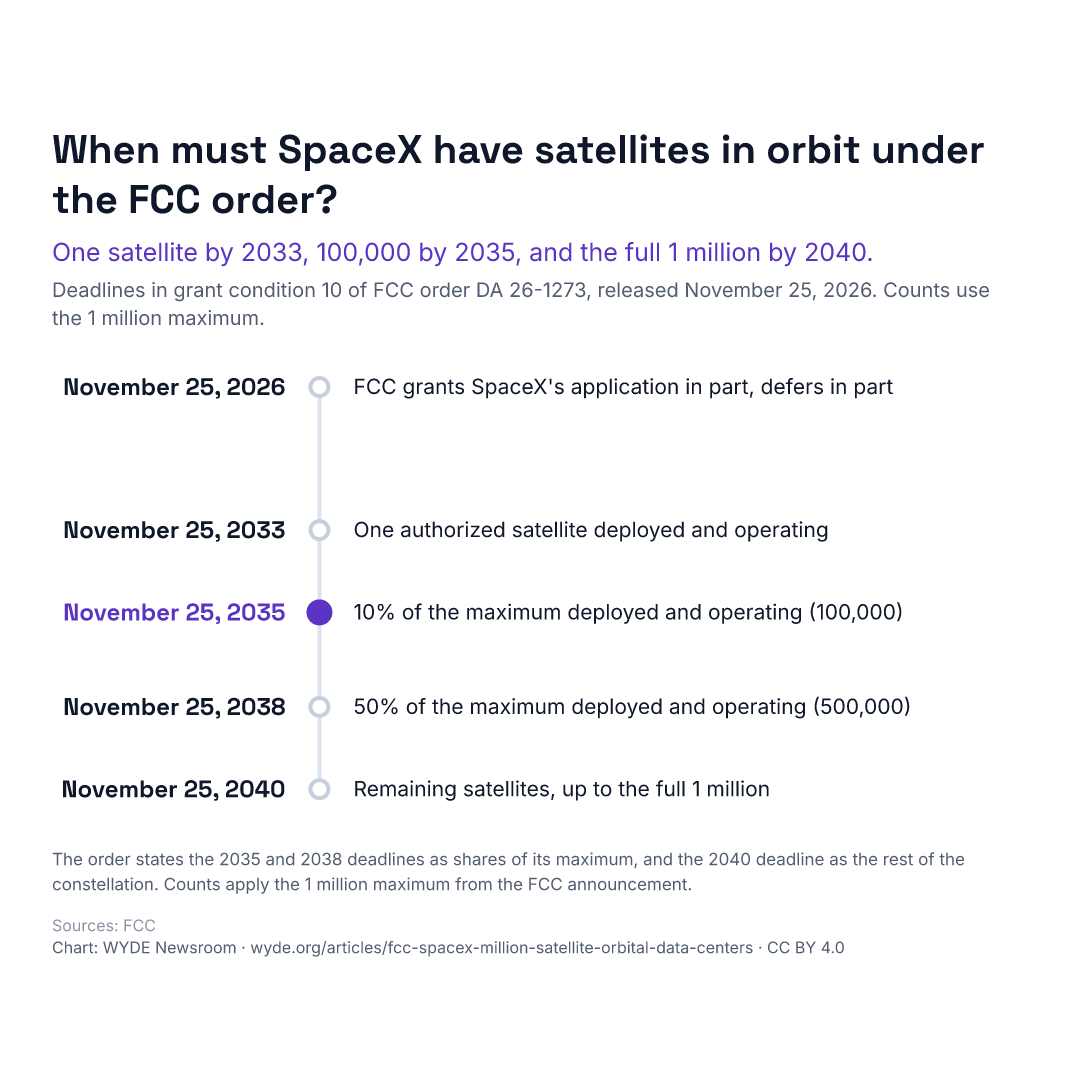
FCC Milestones for SpaceX's Starmind Satellites, 2033 to 2040
Grant condition 10 sets four deadlines. SpaceX must have one authorized space station deployed and operating by November 25, 2033. Then 10% of the maximum number of authorized space stations must be deployed and operating by November 25, 2035. The share rises to 50% by November 25, 2038. All remaining stations needed to complete the authorized constellation must be launched, placed in orbit and operating by November 25, 2040.
Only the first deadline is a count. The FCC's announcement describes the system as up to 1 million orbital data centers, and the order describes the application as a constellation of one million satellites. On that maximum, 10% is 100,000 satellites and 50% is 500,000. One satellite is 0.0001% of 1 million.
Use this chart
Free to republish under CC BY 4.0: credit WYDE Newsroom and link to this article. All WYDE charts.
Credit line
Embed code
Download the chart (PNG, 1200 by 854) · Square version for social posts (1080 by 1080)
Conditions, Waivers and Objections in the FCC Order
The order grants SpaceX's request to waive the surety bond rule, which requires an operator to post a bond payable to the U.S. Treasury. It also grants SpaceX's request to apply new milestones from the FCC's Space Modernization order, FCC 26-47, released July 23, 2026. On its own motion, the FCC waives the frequency table for SpaceX's backup tracking and command links in the 18.8-19.3 GHz and 28.6-29.1 GHz bands, on an unprotected, non-interference basis, which means SpaceX gets no protection and may not cause interference.
The FCC deferred SpaceX's request to waive a disposal rule for satellites ending their missions below 2,000 km. That rule requires atmospheric re-entry as soon as practicable, and no later than five years after the mission ends.
Other conditions require semiannual reports, due each January 1 and July 1, on how many satellites used Ka-band radio frequencies. SpaceX must obtain earth station authorizations before it communicates with any gateway earth stations for Starmind satellites. The order lists a term of 15 years.
Amazon opposed the proposal, CNBC reports, and said it would take SpaceX "centuries" to build the constellation. The order lists three petitions to deny, each filed March 6, 2026: Kuiper Systems LLC (Amazon Leo), Viasat Inc. and the American Astronomical Society.
Chairman Brendan Carr announced the approval on Wednesday. In a post on X, Carr said that "competitor constellations will use solar power to extend America's lead" in AI. Related WYDE coverage: FCC Approves SpaceX's 15,000-Satellite Starlink Mobile Network for Phones.
Why Most of the 1 Million Satellites Fall Due After 2035
The order requires one satellite by 2033, which is 0.0001% of the maximum, and 100,000 by 2035. From 2035 to 2040 the requirement rises by 900,000 satellites, which is 90% of the maximum and falls in the last five years of the schedule. The order gives SpaceX seven years for the first satellite and 14 years for the full constellation, counted from November 25, 2026.
People Also Ask
How many satellites must SpaceX have in orbit by 2035?
The order requires 10% of the maximum number of authorized space stations by November 25, 2035. On the 1 million maximum that the FCC's announcement describes, that is 100,000 satellites.
Who objected to SpaceX's satellite application at the FCC?
CNBC reports that Amazon opposed the proposal. The order lists petitions to deny from Kuiper Systems LLC (Amazon Leo), Viasat Inc. and the American Astronomical Society, each filed March 6, 2026.
Which SpaceX request did the FCC defer?
The FCC deferred SpaceX's request to waive the rule on disposing of satellites that end their missions below 2,000 km. That rule requires atmospheric re-entry no later than five years after the mission ends.
Sources: FCC, FCC order DA 26-1273, CNBC.