

Key Takeaways
- Humyn Labs raised $47 million in a Series A round announced on November 18, 2026.
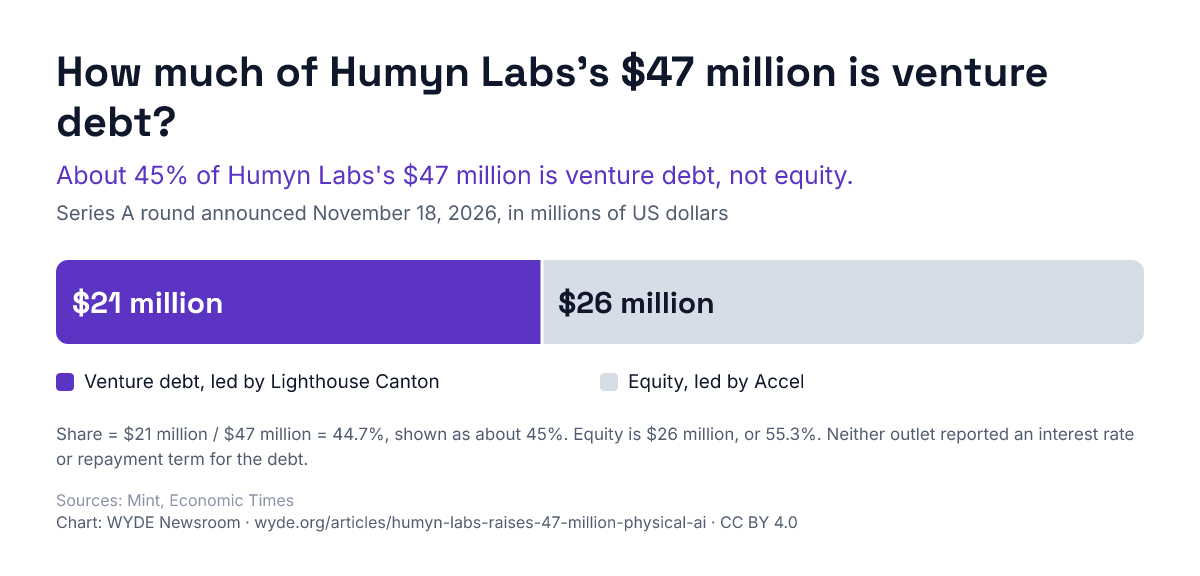
- Venture debt share: about 45% of the $47 million, or $21 million, is a loan rather than equity.
- Humyn Labs investors: Accel led the $26 million equity round, and Lighthouse Canton led the $21 million venture debt.
- Humyn Labs revenue claim: the company said it had surpassed $50 million in annualized revenue within six months.
Humyn Labs raised $47 million in a Series A, an early venture round, announced on November 18, 2026, led by Accel and Lighthouse Canton. Accel led the $26 million equity round, and Lighthouse Canton led the $21 million of venture debt, so about 45% of the total is a loan rather than equity.
Mint described Humyn Labs as a research engine and data platform for Physical AI. Physical AI means AI systems that act in the real world, such as robots. The Economic Times reported that the Physical AI startup, founded in 2026 by Manish Agarwal and Ishank Gupta, was moving beyond collecting training data to helping AI developers test how robots perform in factories, warehouses and other real-world environments.
How the $47 million splits between equity and venture debt
Mint reported the round as $26 million in equity and $21 million in venture debt. The Economic Times reported the same split. Venture debt is a loan, while equity is ownership sold to investors as shares.
Use this chart
Free to republish under CC BY 4.0: credit WYDE Newsroom and link to this article. All WYDE charts.
Credit line
Embed code
Download the chart (PNG, 1200 by 576) · Square version for social posts (1080 by 1080)
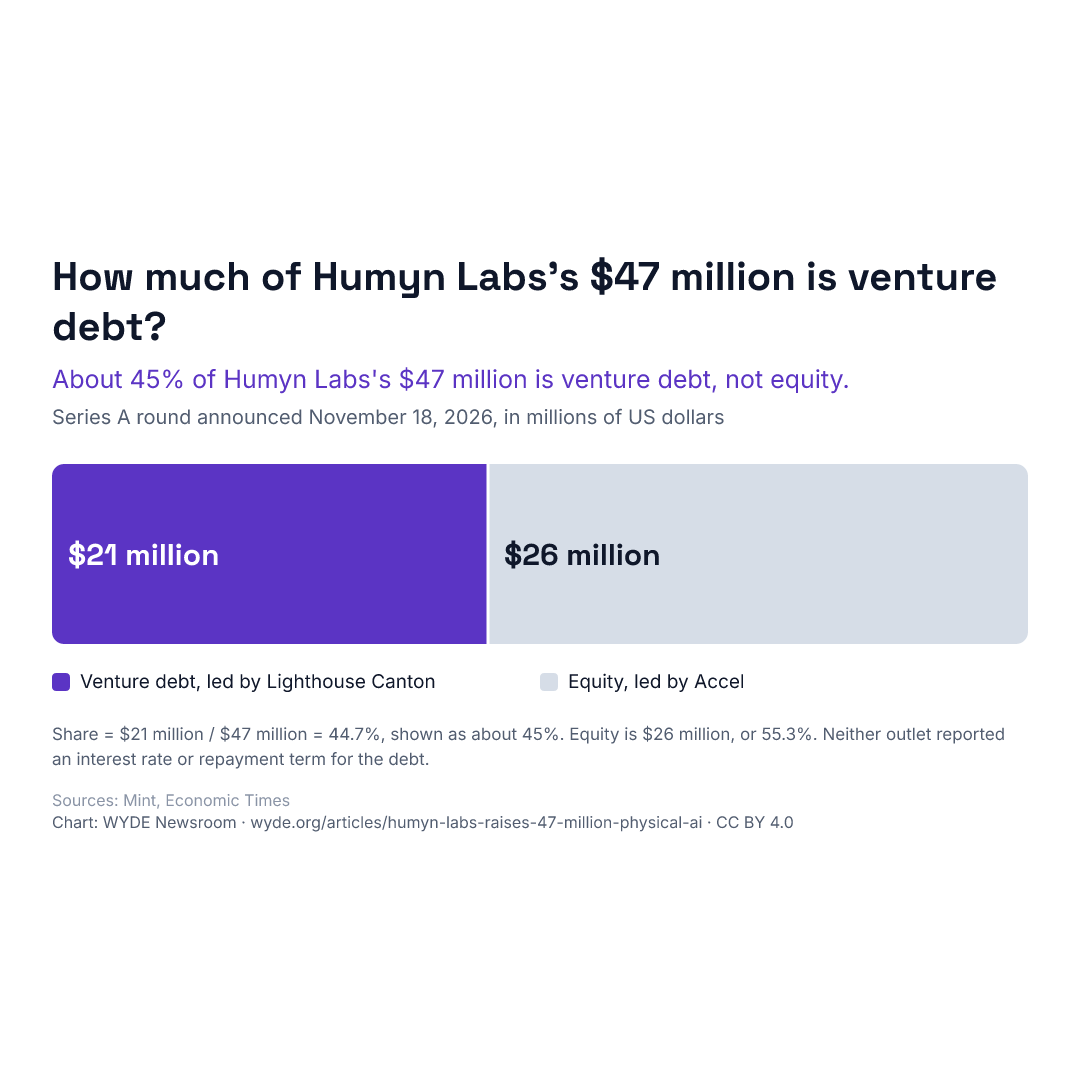
Divide the debt by the total and the share is about 45%. The $21 million is 44.7% of $47 million, and the $26 million in equity is 55.3%. The two outlets gave the dollar amounts but not the share, so the percentage is worked out from their figures.
What venture debt means for the reading of this raise
The $21 million is borrowed. The $26 million equity round gave investors a stake in the company. A reader comparing this round with others should read the $47 million total alongside its split, because a loan and a sale of shares are different claims on the company. Neither outlet reported an interest rate or repayment term for the debt, so its cost cannot be measured from this reporting.
Humyn Labs revenue claim, paying clients and $1 billion target
Humyn Labs claimed to have surpassed $50 million in annualized revenue within six months of operations, Mint reported. Annualized revenue is the revenue a company would earn over a full year at its current pace. The Economic Times said the $50 million claim was up from a reported $10 million in June. That claim is five times the $10 million reported in June.
Mint reported 12 paying clients: nine in the United States, one in Europe and two in India. Nine of the 12, or 75%, are in the United States. The company aimed to become one of the leading global players in Physical AI, targeting $1 billion in revenue. In an interview with the Economic Times, Agarwal said that in a $10 billion-a-year market, "no single player has established itself as the go-to partner."
Ishank Gupta, the other co-founder, compared Physical AI with the large language model (LLM) space, and added: "In my view, the Physical AI space is 10 times bigger than the LLM space because LLMs primarily touch the knowledge workforce, whereas Physical AI will affect all of us."
Where the money goes and what Humyn Labs builds
The Economic Times reported that Humyn Labs would spend the money on deployment centres in Brazil, Korea and India, on its capture hardware and data processing engine, and on teams in San Francisco, London and Seoul. Agarwal told Mint that the company needed the ability to tell frontier labs, which build the brain or both the brain and body of robots, how their models perform in real-world environments. "To do that, we need to build our own engines and models that can identify where these systems are failing."
People Also Ask
How much money did Humyn Labs raise?
Humyn Labs raised $47 million in a Series A round announced on November 18, 2026. The round comprised $26 million in equity and $21 million in venture debt, according to Mint. About 45% of the $47 million is venture debt, so most of the total is equity.
Who led the Humyn Labs funding round?
Accel led the $26 million equity round for Humyn Labs. Lighthouse Canton led the $21 million venture debt component, according to the Economic Times. Lighthouse Canton also appears among the equity investors that the Economic Times lists.
What does Humyn Labs do?
Humyn Labs is a research engine and data platform for Physical AI, according to Mint. The Economic Times reported that Humyn Labs helps AI developers test how robots perform in factories, warehouses and other real-world environments. The company was moving beyond collecting training data, the Economic Times reported.
Who founded Humyn Labs?
Humyn Labs was founded in 2026 by Manish Agarwal and Ishank Gupta. Mint described both founders as serial entrepreneurs.
Sources: Economic Times, Mint.