

Key Takeaways
- The deal: John Deere (NYSE: DE) announced the acquisition of Orchard Robotics, reported November 20, 2026. The company operates as Orchard AI, a San Francisco company founded in 2022. Terms were not disclosed.
- What Orchard had raised: more than $25M, including a $22M Series A in September 2025. PitchBook lists about 45 employees.
- The read on price: Shane Thomas, ag researcher and advisor at Upstream Ag Insights, said the deal "doesn't look like a distressed sale and likely suggests a nine-figure exit for the team and investors." That is an estimate. Deere has not disclosed terms.
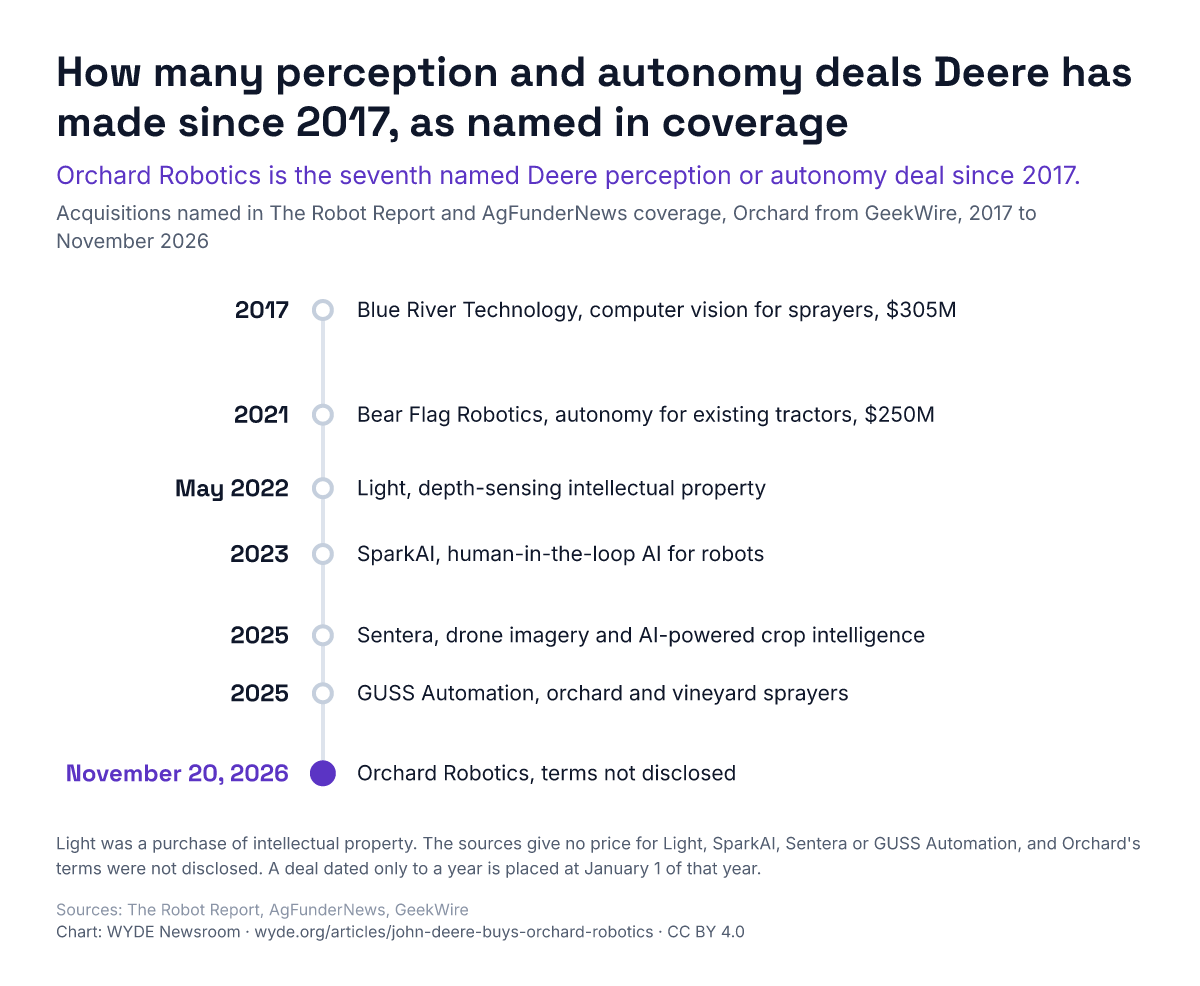
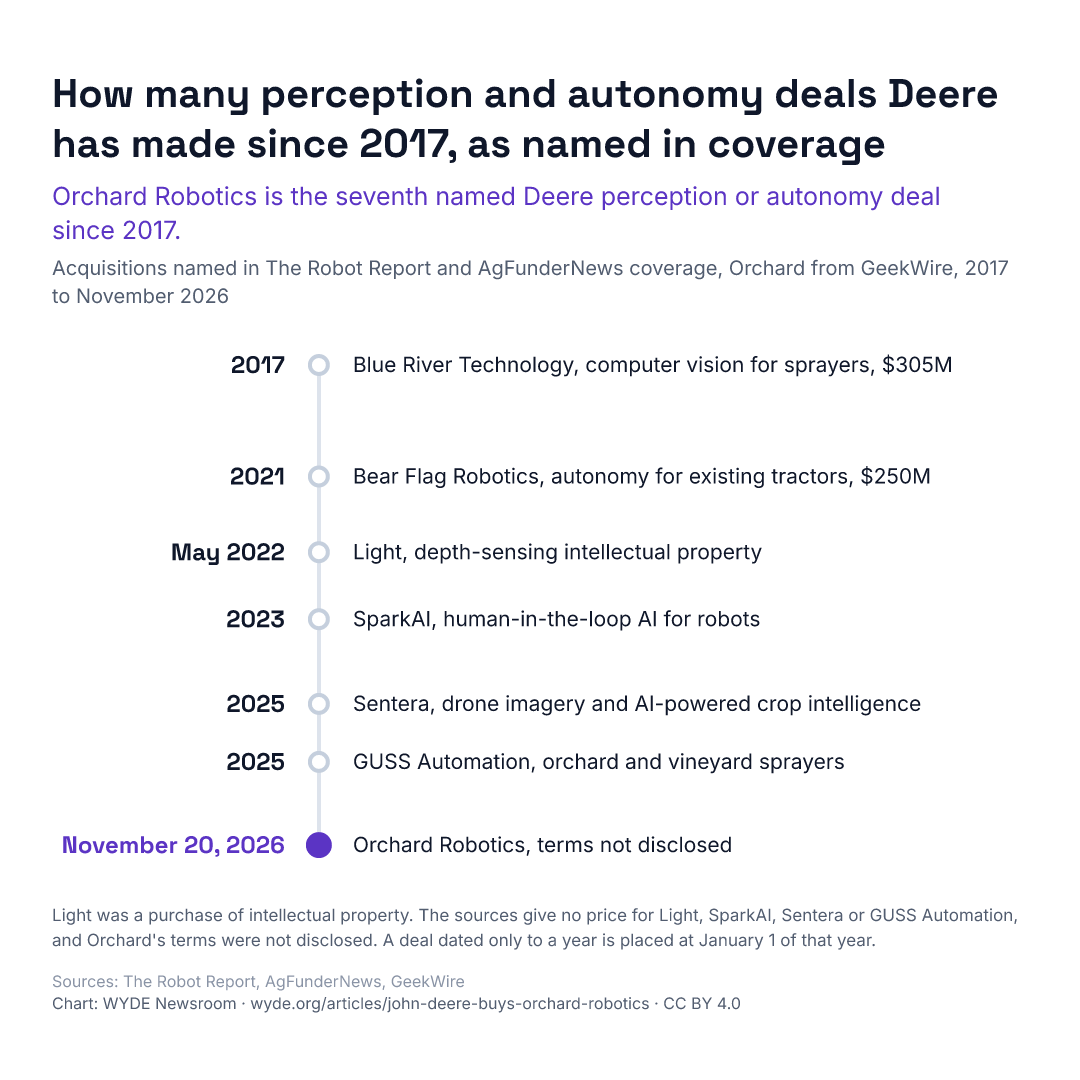
- The pattern: Orchard follows Blue River Technology ($305M, 2017), Bear Flag Robotics ($250M, 2021), Light (2022), SparkAI (2023), Sentera (2025) and GUSS Automation (2025).
John Deere announced the acquisition of Orchard Robotics, reported November 20, 2026. Orchard had raised more than $25M, and terms were not disclosed.
What Deere Bought
Orchard AI mounts AI powered cameras on vehicles and captures millions of images as they travel through orchards and vineyards. Its platform turns that into yield estimates, fruit counts, fruit size and color data and canopy measurements.
"This acquisition connects crop-level intelligence with John Deere technology and equipment that can precisely execute the work in the field," said Tim Marquis, Director of Farm Systems Innovation at John Deere.
The company runs hundreds of systems in the field, covering apples, wine and table grapes, cherries, blueberries, almonds, pistachios and citrus. Founder and CEO Charlie Wu left Cornell to start the company in 2022. AgFunderNews reports the platform can predict yields with 95% or higher accuracy.
"Your average grower does not want to be, nor should they be, a data analyst," Wu said.
This Is the Seventh Named Deal Since 2017
Deere has been making perception, the sensing that lets a machine read its surroundings, and autonomy deals since 2017, when it paid $305M for Blue River Technology, whose computer vision let sprayers identify weeds and treat them selectively. Bear Flag Robotics, which retrofitted autonomy onto existing tractors using cameras, lidar and radar, followed in 2021 for $250M. In May 2022 Deere acquired intellectual property from Light for camera based depth sensing. In 2023 it bought SparkAI, which uses humans in the loop to help robots resolve edge cases. In 2025 it took Sentera, a drone imagery and AI-powered crop intelligence company, and GUSS Automation, maker of autonomous orchard and vineyard sprayers it had already been selling exclusively.
Use this chart
Free to republish under CC BY 4.0: credit WYDE Newsroom and link to this article. All WYDE charts.
Credit line
Embed code
Download the chart (PNG, 1200 by 986) · Square version for social posts (1080 by 1080)
The Strategy Has a Date Attached
Deere unveiled its first fully autonomous tractor in January 2022. That May, at its Leaps Unlocked event, Igino Cafiero, then CEO of Bear Flag Robotics, said Deere had planned a fully autonomous corn and soybean production system by 2030, covering spring tillage, planting, spraying, harvest and fall tillage. Jorge Heraud, who sold Blue River to Deere and later became its Vice President of Automation and Autonomy, tied the robotics and AI line to a $150B incremental addressable market.
At CES 2025, Deere showed an autonomous 9RX tractor and an autonomous 5ML orchard tractor for air blast spraying. At CES 2026 it brought the X9 1100 combine, which delivers up to 30% productivity gains for farmers while essentially driving itself, plus a road paver made in collaboration with Vögele. The combine still needs an operator in the seat.
"The precision allows us to help the environment," said Aaron Wetzel, Vice President of Production and Precision Ag Production Systems. "Because this way, we're putting fewer chemicals in the fields. And there's no wait. This machine is available worldwide." "So this is just the beginning."
Labor Is the Reason Deere Gives for Autonomy
Deere has given labor as its reason for autonomous machines."There simply isn't enough available and skilled labor to do that work in a timely and efficient manner," a Deere speaker said at CES 2025, citing an aging farm workforce and rural to urban migration.
The Bureau of Labor Statistics projects employment of agricultural workers to fall 2% from 2025 to 2035. A Purdue University survey in May found about 44% of farmers who hire nonfamily workers had some or a lot of difficulty hiring this year.
Deere's Results Came Five Days After the Deal Was Reported
Deere reported fourth quarter results on November 25. Net income came in at $1.051B, down 1%, on net sales and revenues of $12.115B, down 2%. Full year net income was $4.860B, down 3%, on revenues of $47.704B, up 4%.
Deere forecast fiscal 2027 net income of $4.50B to $5.25B, including an estimated one-time, non-cash pension charge of $0.25B to $0.40B associated with a voluntary lump-sum payment option for certain U.S. salaried retirees. "As we enter fiscal 2027, we're seeing early signs of improvement in large agriculture, led by North America," said Chairman and Chief Executive Officer John May.
What Others in Agtech Read Into It
Jorge Heraud called the deal "further validation that large companies in agriculture are finding that actionable data is very valuable to farmers."
Danny Bernstein, CEO of Reservoir Farms, said it is "a strong signal that super intelligence is strategic for the future of agriculture," and that it shows a real exit path for companies building rugged outdoor physical AI.
Coverage does not say how Orchard AI will be integrated into Deere's product lines or on what timeline, or whether its platform will stay available to growers on non-Deere equipment. Charlie Wu said Orchard will continue operating as a Deere subsidiary with its existing team and products, and that the goal is to bring its technology to every farmer out there.
People Also Ask
How much did John Deere pay for Orchard AI?
Terms were not disclosed. Shane Thomas of Upstream Ag Insights estimated a nine figure outcome. Orchard Robotics had raised more than $25M, including a $22M Series A in September 2025.
What does Orchard AI's technology do?
Vehicle mounted AI cameras capture millions of images as they travel through orchards and vineyards. Orchard's platform converts that into fruit counts, fruit size and color, canopy measurements and yield estimates.
What is John Deere's autonomy goal?
Igino Cafiero, then CEO of Bear Flag Robotics, said in May 2022 that Deere had planned a fully autonomous corn and soybean production system by 2030, covering spring tillage, planting, spraying, harvest and fall tillage.
How many perception or autonomy deals has Deere made since 2017?
Orchard AI is the seventh named perception or autonomy deal since 2017. The six named deals before it were Blue River Technology, Bear Flag Robotics, SparkAI, Sentera and GUSS Automation, which Deere acquired as companies, and Light, from which Deere bought intellectual property.
Sources: John Deere newsroom, GeekWire, AgFunderNews on the acquisition, AgFunderNews on the Series A, AgFunderNews on CES 2025, The Robot Report, Precision Farming Dealer, Under the Hard Hat on CES 2026, Deere Q4 FY2026 results, Bureau of Labor Statistics, Purdue University.