Key Takeaways
- Peraire-Bueno brothers acquitted of wire fraud and related charges over a $25 million Ethereum maximal extractable value (MEV) exploit by a Manhattan federal judge, The Block reported on November 16, 2026.
- Wire fraud ruling: the judge found prosecutors did not prove the material misrepresentation the charge requires.
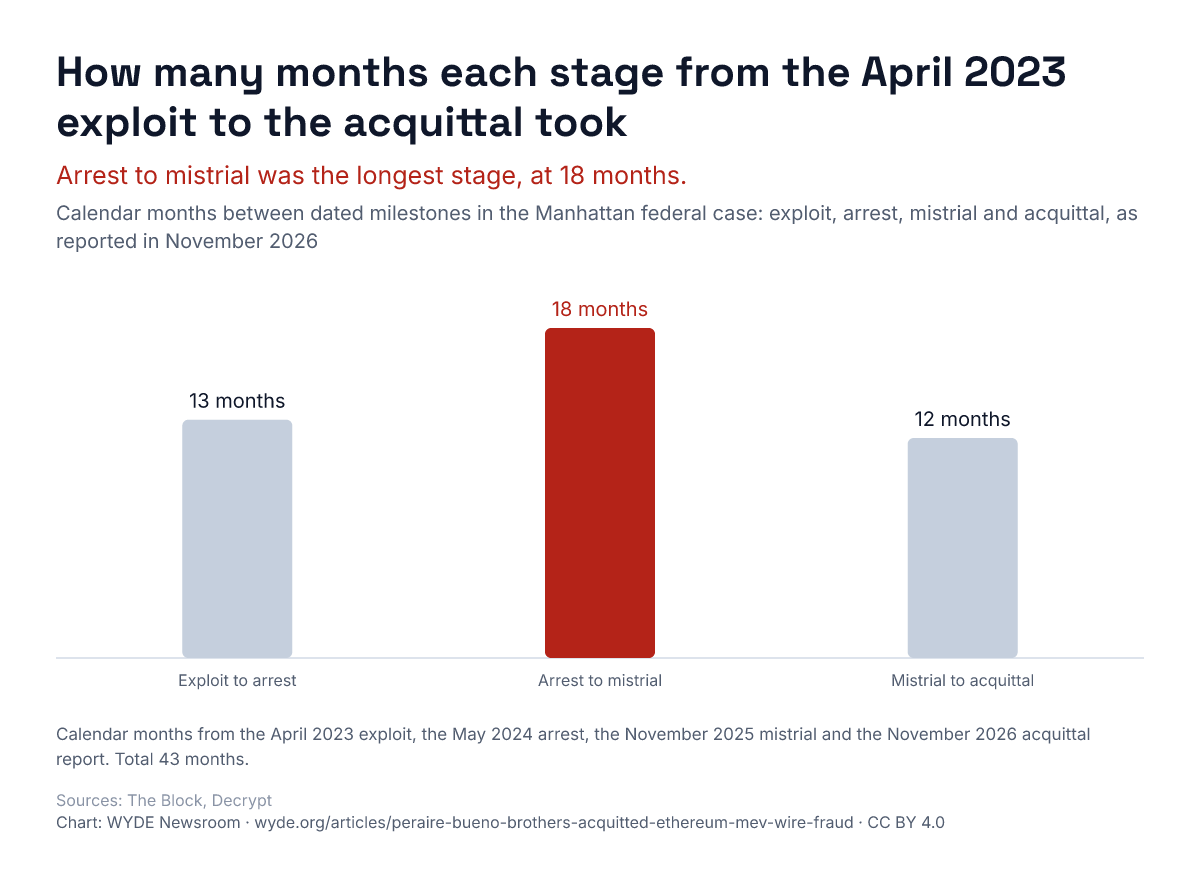
- Ethereum MEV case timeline: 43 months from the April 2023 exploit to the acquittal reported in November 2026, with a mistrial in between.
Peraire-Bueno brothers acquitted: MIT-educated Anton and James Peraire-Bueno were cleared of wire fraud and related charges by a Manhattan federal judge over a $25 million Ethereum MEV exploit, a ruling The Block reported on November 16, 2026. The judge found that prosecutors failed to prove the material misrepresentation needed for wire fraud, a year after a jury deadlocked. To convict on wire fraud, prosecutors had to show the brothers made a material misrepresentation, and none of the government's theories did so, she found.
The April 2023 MEV bot exploit and the 2024 arrests
The case stemmed from an April 2023 exploit that targeted so-called sandwich bots, automated traders that profit from maximal extractable value (MEV) by placing their own trades on either side of other users' transactions, Decrypt reported. The Block reported that a group of MEV bots lost over $25 million in seconds. The attacker had replaced the bots' normal MEV transactions with malicious ones, causing them to lose money. The case stemmed from that April 2023 exploit, and the acquittal reported on November 16, 2026 came 43 months after it.
In May 2024, Anton and James Peraire-Bueno were arrested after prosecutors said they exploited the Ethereum blockchain, The Block reported. The Block described the case as involving maximal extractable value, the maximum amount of value that can be extracted from a given decentralized finance (DeFi) protocol or smart contract by a user or group of users.
The November 2025 mistrial and Coin Center's view
A mistrial was declared in November 2025 after the jury deadlocked in Manhattan federal court, The Block reported. "A mistrial is not at all surprising to me because, gosh, if I wasn't a crypto person and I was on that jury, I would just be incredibly confused," Van Valkenburgh said at the time.
Coin Center executive director Peter Van Valkenburgh told The Block that the case was a "massive overstep."
How long the Peraire-Bueno case ran, stage by stage
The acquittal reported on November 16, 2026 came 43 months after the April 2023 exploit. Counted in calendar months, the exploit to the May 2024 arrest took 13 months, the arrest to the November 2025 mistrial took 18 months, and the mistrial to the acquittal took 12 months. Decrypt described the ruling as coming a year after the jury deadlocked.
Use this chart
Free to republish under CC BY 4.0: credit WYDE Newsroom and link to this article. All WYDE charts.
Credit line
Embed code
Download the chart (PNG, 1200 by 876) · Square version for social posts (1080 by 1080)
Why the judge ruled the trading strategy did not constitute criminal fraud under the statutes cited by prosecutors
Clarke found that none of the government's theories showed the material misrepresentation that wire fraud requires, Decrypt reported. The Block reported that the judge found the trading strategy did not constitute criminal fraud under the statutes cited by prosecutors. "The question before the Court is not whether the Peraire-Buenos' conduct was right or moral, or even whether it violated uncharged crimes," Clarke wrote.
Clarke said the brothers' scheme "may have frustrated the spirit" of MEV-Boost, software that lets Ethereum validators outsource the ordering of transactions to specialized block builders, but that was not enough to make out fraud. Clarke also noted that Ethereum is a "trustless, highly adversarial environment with no terms of use."
What the acquittal decides and what the ruling leaves open
Decrypt's headline describes the ruling as ending the prosecution. In a footnote, Clarke added that the prosecution "raises serious due process concerns," though she declined to rule on that question. The sources cited here do not say whether the reasoning applies beyond this case.
For readers tracking MEV, the case shows how a court reads a trading strategy that prosecutors accused of exploiting Ethereum's transaction ordering system. The judge's answer turned on whether prosecutors could show a misrepresentation, not on whether the trades were right.
People Also Ask
What did the judge rule in the Peraire-Bueno brothers case?
A Manhattan federal judge acquitted Anton and James Peraire-Bueno of wire fraud and related charges over a $25 million Ethereum MEV exploit. The judge found that prosecutors did not prove the material misrepresentation needed for wire fraud.
What is maximal extractable value on Ethereum?
Maximal extractable value, or MEV, is the maximum amount of value that can be extracted from a given DeFi protocol or smart contract by a user or group of users, The Block reported. Decrypt described sandwich bots as automated traders that profit from MEV by placing their own trades on either side of other users' transactions.
When were Anton and James Peraire-Bueno arrested?
Anton and James Peraire-Bueno were arrested in May 2024 after prosecutors said they exploited the Ethereum blockchain. The Block dated the arrests to May 2024, and the April 2023 exploit came 13 months earlier.
Why was there a mistrial in the Peraire-Bueno case?
The sources cited here do not give a reason for the deadlock. A mistrial was declared in November 2025 after the jury deadlocked in Manhattan federal court, The Block reported. The acquittal came about a year later, Decrypt reported.