
Key Takeaways
- Fake crypto trading platforms: the SEC alleges eight Colorado-based entities took more than $37 million from U.S. investors.
- Fake crypto investment scam: the SEC alleges social media ads and private chats steered investors to supposed crypto asset trading platforms.
- Four fake adviser and platform pairs: the SEC alleges they ran one after another from August 2024 through May 2026.
- Average per investor: about $24,700, by our arithmetic from the SEC's more than $37 million and the more than 1,500 investors that Bitcoin Magazine says the complaint counts.
The Securities and Exchange Commission charged eight Colorado-based entities, including Advisor WeChat Capital and Tech Brokerage Asset Alliance, on Thursday, November 19, 2026, over fake crypto trading platforms that allegedly took more than $37 million from U.S. investors. Bitcoin Magazine, citing the complaint, names the entities as four adviser and platform pairs: Advisor WeChat Capital with Tech Brokerage Asset Alliance, HB Wealth Advisors with IdeaCrypto Exchange, Convergent Wealth Advisors with RealSimple Crypto Exchange, and Associated Wealth Advisors with Essential Crypto Exchange. The SEC alleges the defendants lured investors to believe they were dealing with a real investment adviser and crypto asset trading platform, when both were fake. The SEC alleges the fake crypto trading platform scheme took more than $37 million, and the complaint counts more than 1,500 investors, so the average of about $24,700 per investor is a WYDE estimate.
How the SEC says the fake adviser and crypto platform scheme lured investors
The SEC brought its case by filing a complaint, the document that starts a lawsuit, in the U.S. District Court for the District of Colorado. It says the defendants advertised on social media and directed investors to group and private chats. The chats were controlled by individuals, likely from overseas, who claimed to be tied to an alleged investment adviser. The people in the chats first advised investors to trade stocks on U.S. markets, then urged victims to send as much money as possible to a supposed crypto asset trading platform. Bitcoin Magazine reported that the SEC alleges none of the crypto assets investors thought they were buying existed. The SEC says the advisers and platforms were fronts, meaning covers, used to steal investor money. The SEC also says the defendants made fake SEC certificates, made filings with the SEC, the Financial Industry Regulatory Authority (FINRA) or the Financial Crimes Enforcement Network (FinCEN), and directed skeptical investors to those certificates and filings.
"The SEC continues to seek out and expose fraudulent investment scams that prey on U.S. investors," said Laura D'Allaird, chief of the SEC Enforcement Division's Cyber and Emerging Technologies Unit.
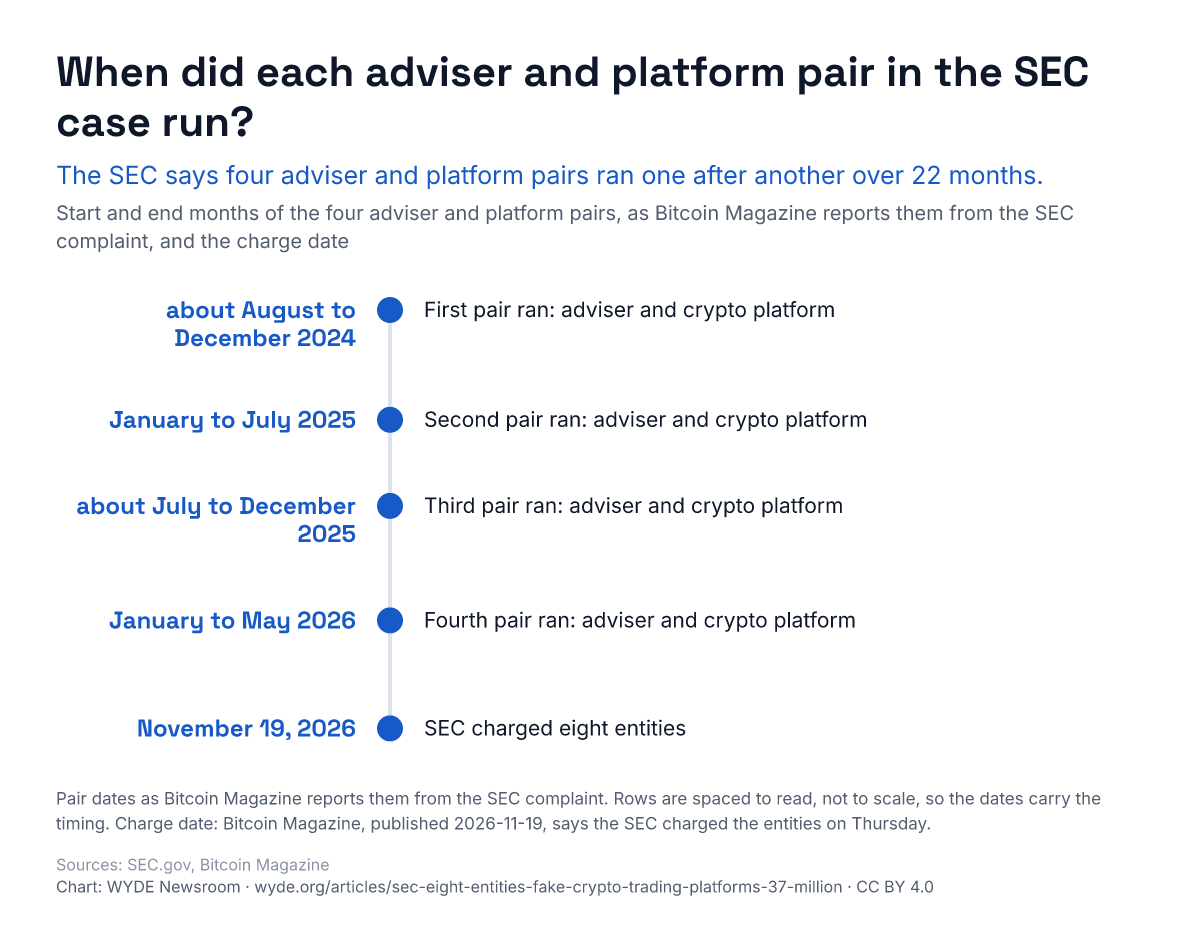
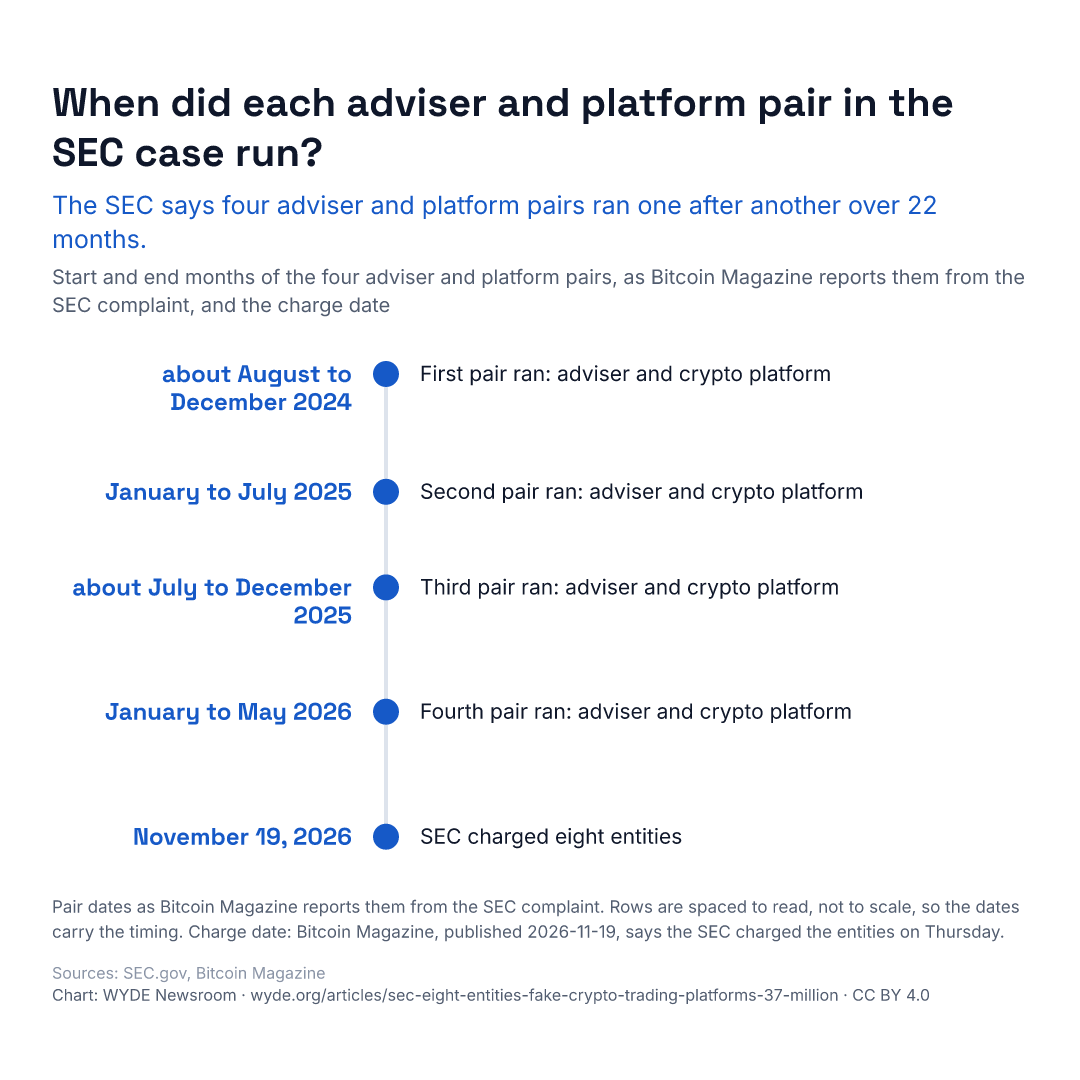
Four fake adviser and platform pairs the SEC says ran from August 2024 to May 2026
The complaint describes four adviser and platform pairs, each combining one adviser with one platform. The SEC says the defendants abandoned one pair for the next after operating for a few months. Bitcoin Magazine's account of the complaint dated them. The first pair operated from about August to December 2024. The second ran from January to July 2025. The third ran from about July to December 2025. The fourth ran from January to May 2026. Counting both end months, the scheme covered 22 months, and each pair ran for five to seven months.
Use this chart
Free to republish under CC BY 4.0: credit WYDE Newsroom and link to this article. All WYDE charts.
Credit line
Embed code
Download the chart (PNG, 1200 by 941) · Square version for social posts (1080 by 1080)
Three investors lost between nearly $500,000 and close to $1.6 million
Bitcoin Magazine described three unnamed investors whose losses illustrate the damage. One lost nearly $500,000, and that total included a 401(k) loan and money borrowed from a son and a neighbor. A second investor lost about $850,000, and part of that came from cashing out a 401(k). A third investor lost close to $1.6 million, a total that included the investor's house and IRA. A 401(k) is a workplace retirement savings plan, and an IRA is an individual retirement account.
Average amount taken per investor in the SEC case
The three cases above are roughly 20 to 65 times the average of about $24,700 per investor, so the average hides large individual losses.
People Also Ask
What did the SEC charge in the fake crypto trading platform case?
The SEC charged eight Colorado-based entities with defrauding U.S. investors out of more than $37 million through fake investment advisers and fake crypto asset trading platforms. The SEC says the advisers and platforms were simply fronts to steal investor money. The charges were announced on Thursday, November 19, 2026.
How did the SEC say the fake crypto trading platforms lured investors?
The SEC's complaint says the eight Colorado-based entities advertised on social media and steered investors into group and private chats. The people in the chats first advised trading stocks on U.S. markets, then urged victims to send money to a supposed crypto asset trading platform. The SEC says the eight Colorado-based entities made fake SEC certificates and made filings with the SEC, FINRA or FinCEN to feign legitimacy.
How long did the fake crypto trading platform scheme run?
The SEC says the scheme ran from August 2024 through May 2026, in four adviser and platform pairs. By our count of the dates, each pair ran five to seven months. Each new pair started as the one before it ended.
How many investors did the SEC say the fake crypto trading platforms defrauded?
Bitcoin Magazine reported that the complaint counts more than 1,500 investors as victims. The SEC's figure for the total taken is more than $37 million.
Sources: SEC.gov, Bitcoin Magazine.