

Key Takeaways
- South Korea's won stablecoin draft bill would limit issuance to bank-majority consortiums, according to CurrencyAnalytics.
- Won stablecoin issuers would need at least 5 billion won, about $3.72 million, in equity capital.
- Stablecoin reserve assets would have to equal at least 100% of outstanding issuance, according to UPI.
- The bill is a draft, and its specific details await implementing regulations (rules written later to carry out the bill).
The South Korea won stablecoin bill, unveiled by the Financial Services Commission, would require at least 5 billion won in equity capital, as UPI reported on November 24, 2026, and would limit issuance to bank-majority consortiums, per CurrencyAnalytics. UPI reported a bank-led stablecoin framework on November 24, 2026, and CurrencyAnalytics reported the draft on November 25. It is a draft, not a launch. Tiger Research, as reported by CurrencyAnalytics, says that if the 15% ownership limit for nonfinancial companies in banks applies to these consortiums, at least four banks would have to join each group to secure a majority stake. WYDE's arithmetic on that 15% limit: three banks at 15% each would hold 45%, short of a majority, and four would hold 60%.
South Korea won stablecoin bill terms: equity, reserves and ownership
Under the draft, issuers would need at least 5 billion won, about $3.72 million, in equity capital. They would also have to satisfy shareholder composition requirements before obtaining authorization from the financial regulator, according to UPI. UPI does not spell out the shareholder composition requirements. Issuers would have to deposit or place in trust reserve assets of at least 100% of their outstanding stablecoin issuance with banks or other authorized reserve asset managers. UPI gives the minimum in won, with a dollar figure of about $3.72 million. That dollar figure moves with the exchange rate.
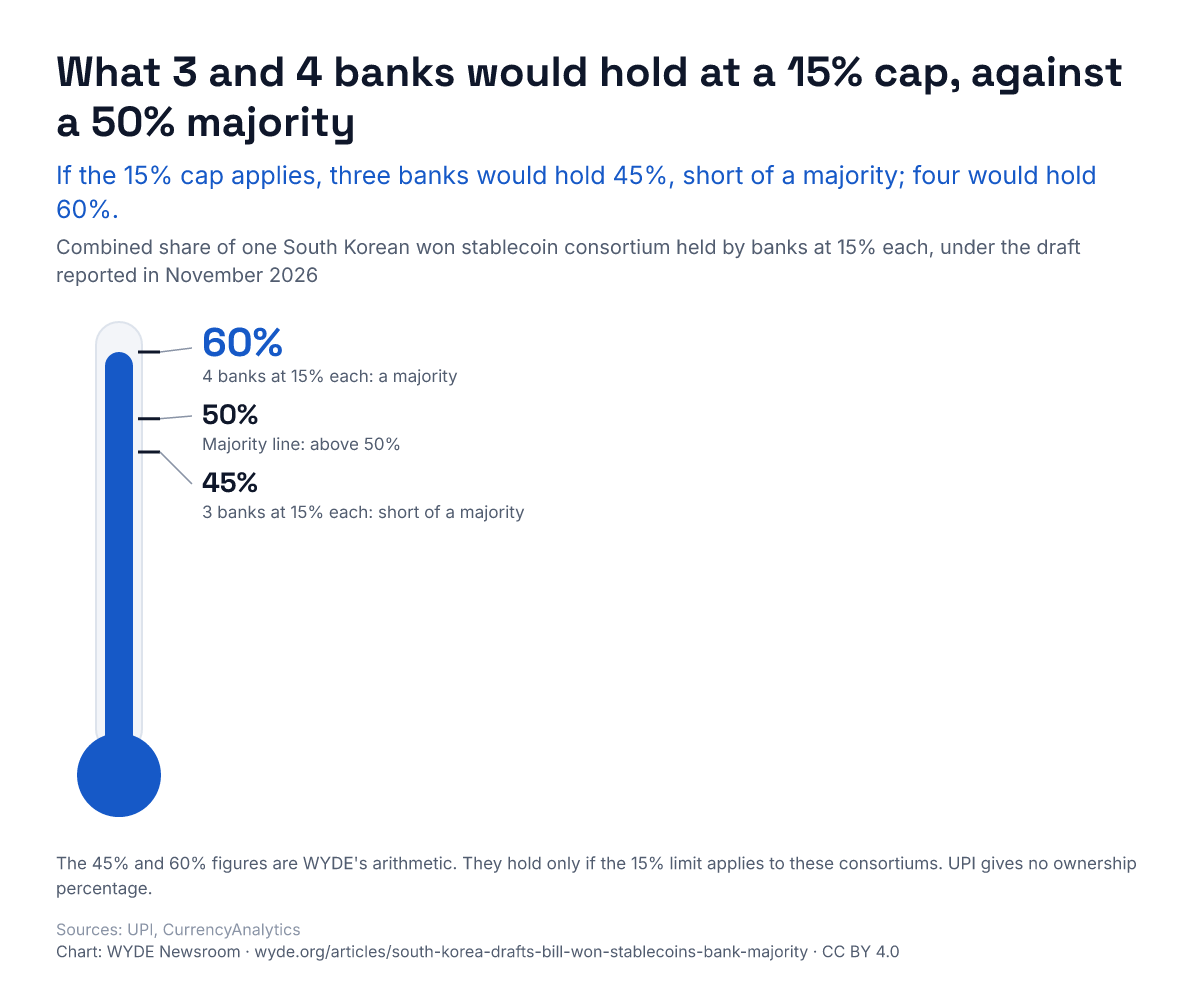
Use this chart
Free to republish under CC BY 4.0: credit WYDE Newsroom and link to this article. All WYDE charts.
Credit line
Embed code
Download the chart (PNG, 1200 by 1006) · Square version for social posts (1080 by 1080)
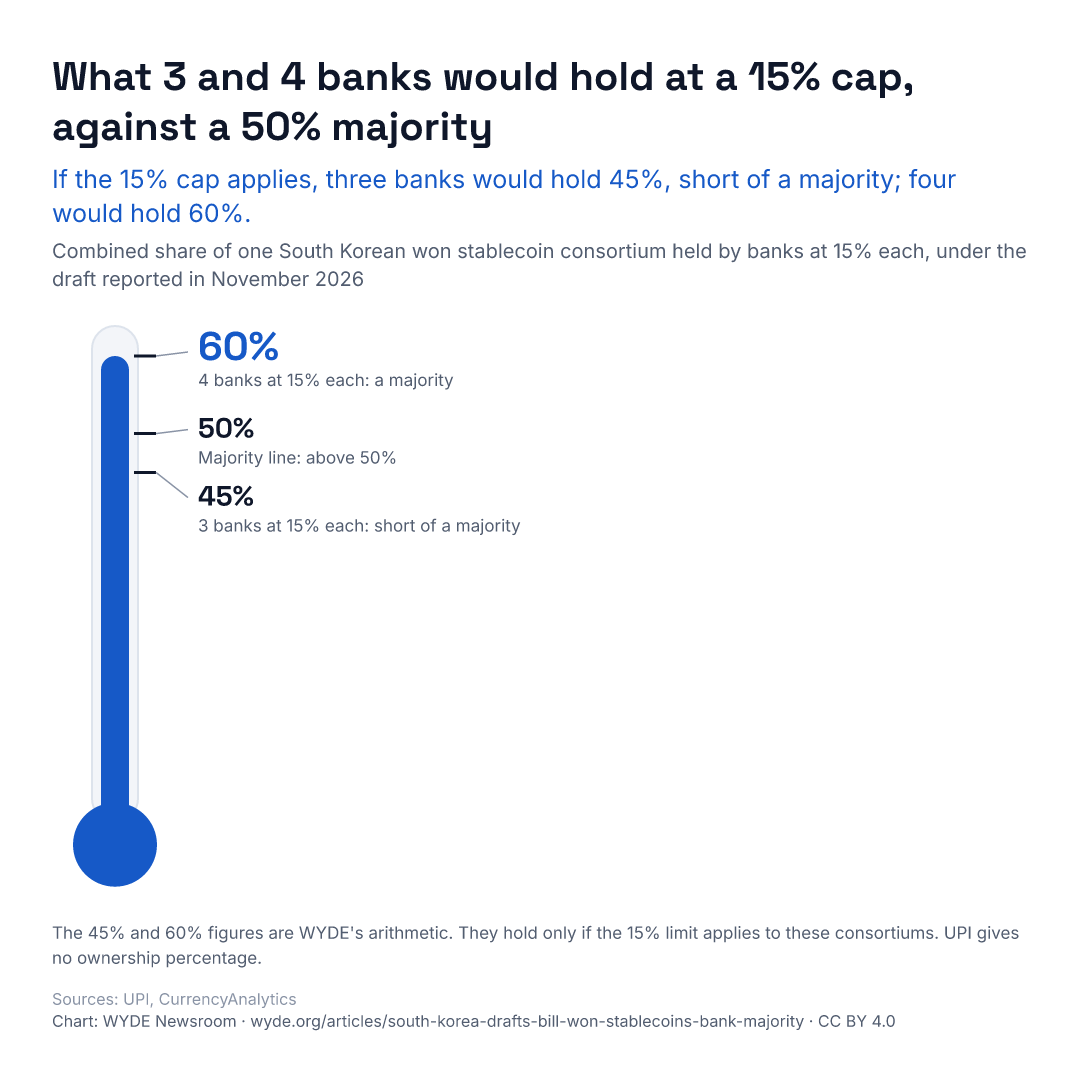
A stablecoin is a digital token meant to hold a steady value against a currency. A consortium is a group of companies that join forces on one venture. Reserve assets are the holdings that back each token. Under this draft, the reserve test is 100%, so each unit of outstanding stablecoin issuance needs at least one unit of reserve assets behind it.
The two outlets word the ownership test differently. UPI describes bank-led consortia and shareholder composition requirements, with no percentage given. CurrencyAnalytics says the draft limits won stablecoin issuance to bank-majority consortiums, meaning banks would hold the majority of each consortium.
Why the bank-majority test decides who can issue won stablecoins
UPI reports that the proposal prompted major banks to expand their digital asset plans. CurrencyAnalytics cites a Tiger Research note that reads the 15% ownership limit for nonfinancial companies in banks, set by the Banking Act, as a possible limit on these consortiums. If that limit applies, the requirement could favor larger financial institutions that can meet the four-bank threshold.
The four-bank conclusion comes from Tiger Research, as reported by CurrencyAnalytics. UPI's report does not contain that arithmetic. The result depends on the 15% limit applying to these consortiums, and UPI gives no percentage for the bank-ownership test.
The draft therefore sets rules for two questions. Who may issue is set by the bank-majority test, which the two outlets describe in different words. What backs each token is set by the 100% reserve rule, which UPI states as a fixed minimum. The 5 billion won equity floor applies alongside both.
What the draft leaves to implementing regulations
A banking industry official said, "Although the specific details will have to wait until the implementing regulations are released, we are preparing for all possibilities involving the services we anticipate." The official's words describe preparation while the specific details remain pending.
Neither report gives a date for the implementing regulations. UPI's report is dated November 24, 2026, and CurrencyAnalytics' report is dated November 25, 2026. The bill is still a draft, and UPI reports that its specific details await implementing regulations. Under the proposal, issuers must meet the equity and shareholder composition requirements before obtaining authorization.
People Also Ask
How much equity capital does a won stablecoin issuer need under the draft?
The draft bill unveiled by South Korea's Financial Services Commission requires at least 5 billion won, about $3.72 million, in equity capital. Issuers must also meet shareholder composition requirements before they obtain authorization from the financial regulator, according to UPI.
Do won stablecoin reserves have to cover all outstanding issuance?
The draft requires reserve assets of at least 100% of an issuer's outstanding stablecoin issuance, according to UPI. Those reserve assets must be deposited or placed in trust with banks or other authorized reserve asset managers.
Who can issue won stablecoins under South Korea's draft bill?
CurrencyAnalytics reports that the draft limits won stablecoin issuance to bank-majority consortiums. UPI describes the same proposal as allowing bank-led consortia to issue won-backed stablecoins.
Is South Korea's won stablecoin framework already in effect?
The framework is still a draft. UPI reported the Financial Services Commission's draft bill on November 24, 2026, and says the specific details will wait for implementing regulations.
Sources: UPI, CurrencyAnalytics.