

Key Takeaways
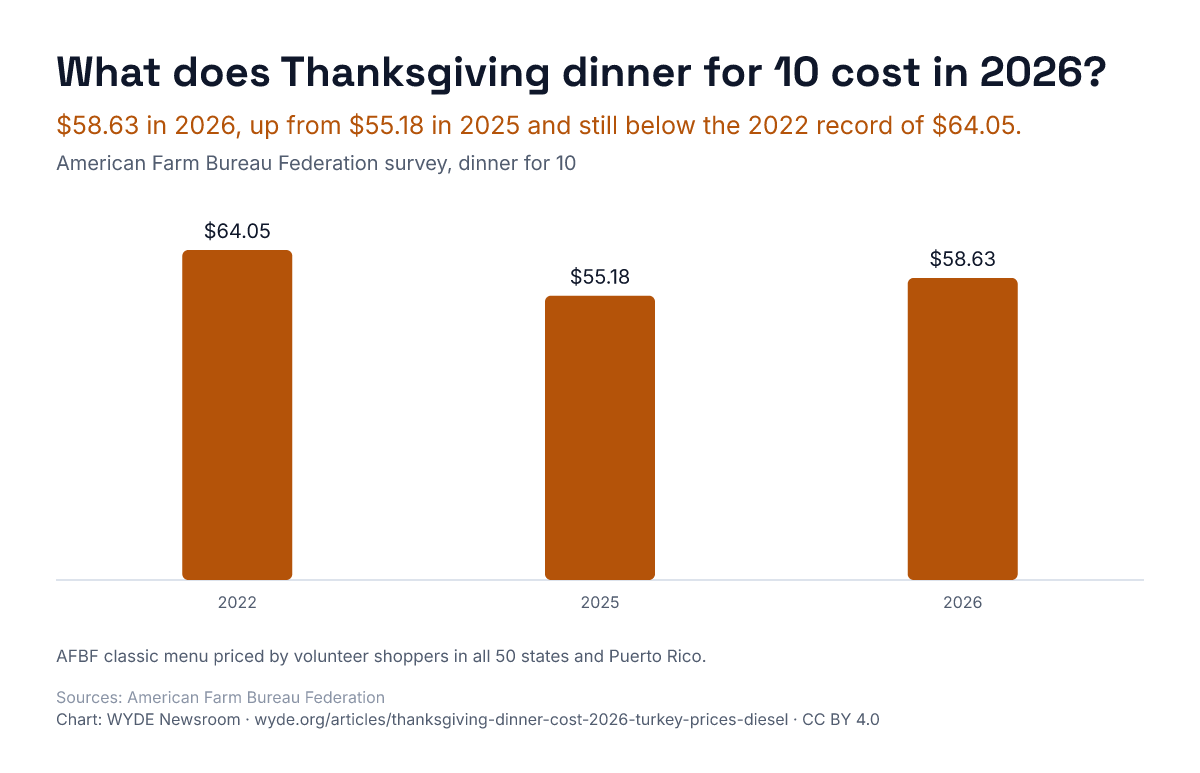
- AFBF 2026 estimate: $58.63 for a 10 person Thanksgiving dinner, up more than 6% from $55.18 in 2025, and the first rise the bureau has reported since the 2022 record of $64.05.
- Turkey is the main driver: a 16lb frozen bird averages $23.68, up $2.18 or 10%. USDA puts the 2026 market price of 8 to 16lb turkeys at 177.0 cents/lb against 135.8 cents/lb last year, a rise of about 30%.
- Energy sits upstream: diesel hit a record US average of $6.53 a gallon in September, according to AAA, following disruption in the Strait of Hormuz since the Iran war began in February.
- A competing estimate: the Wells Fargo Agri-Food Institute found the average Thanksgiving food bill will come in slightly cheaper than last year, due in part to sales and promotions.
The American Farm Bureau Federation estimates that a Thanksgiving dinner for 10 will cost $58.63 in 2026, more than 6% above the $55.18 it recorded in 2025. It is the first increase the bureau has reported since 2022, when the figure reached a record $64.05. The estimate comes from hundreds of volunteer shoppers in all 50 states and Puerto Rico, who price a standard list of items at their local grocery store. Dinners in the Northeast are set to be the most expensive and dinners in the South the least.
Turkey Prices Carry Most of the Thanksgiving Dinner Increase
The bureau points at turkey as the main driver. A 16lb frozen bird averages $23.68, up $2.18 or 10% from last year's $21.50, according to the bureau's 2026 and 2025 releases. The bureau's own market note, and TIME, print the rise as $2.38, which does not match the bureau's 2025 and 2026 prices. By WYDE's arithmetic, the $2.18 is about 63% of the $3.45 rise in the whole dinner. USDA's November outlook puts the 2026 average market price for 8 to 16lb turkeys at 177.0 cents/lb against 135.8 cents/lb in 2025, a rise of about 30%.
Use this chart
Free to republish under CC BY 4.0: credit WYDE Newsroom and link to this article. All WYDE charts.
Credit line
Embed code
Download the chart (PNG, 1200 by 773) · Square version for social posts (1080 by 1080)
Demand is part of it. "Lean protein has really boosted demand worldwide for things like chicken and turkey," says Dr. Faith Parum, deputy chief economist at the AFBF. Total US turkey meat exports are projected to reach 459M pounds by the end of the year, against 420M pounds last year, after USDA trimmed its forecast from 461M in November.
Supply is still recovering. Spikes in highly pathogenic avian influenza in 2022, 2023 and 2024 hit turkey and egg laying hens hardest. "We have seen a decrease in the number of cases, but it still takes time for those flocks to fully recover," Parum says.
Energy Is the Cost That Travels Fastest
Diesel reached a record US average of $6.53 a gallon in September, according to AAA, after severe disruption in the Strait of Hormuz, a route through which around a fifth of global oil production flowed before the Iran war began in February. Diesel powers farm machinery and the trucks that move food.
"Diesel prices are very integral in food pricing," Parum says. "If you remember food price inflation after Russia invaded Ukraine [in 2022], a lot of that was due to high energy prices, so we're seeing similar things now."
Perishable goods absorb it first. "The poultry supply chain is highly elastic, where we see upstream cost impacts pass through quickly and pretty efficiently," says Ricky Volpe, professor in agribusiness at California Polytechnic State University. "Unfortunately for holiday shoppers, the recent surge in energy prices reflects that." Cattle are fed and grown over a longer period than turkeys, so beef is less exposed to an immediate energy shock. Milk posted some of the largest year over year gains, which Volpe attributes to a short, temperature controlled and energy intensive supply chain.
Planting Costs and a Thin Labor Market Add to the Bill
Turkey feed in the US is usually corn and soybeans, and both cost more to grow. USDA puts total operating costs for a planted acre of corn at a forecast $496.92 in 2026 against $455.80 in 2025. For soybeans the figures are $266.45 against $250.88.
"The cost of planting was really high in the last season," says Jada Thompson, associate professor in agricultural economics and agribusiness at the University of Arkansas. "The cost of urea and fertilizer was so high that it was affecting farmers' break-even price." Urea prices rose sharply in the months after the Iran war started, hitting farmers during spring planting.
Labor is tight as well. Employment of agricultural workers is set to decline 2% by 2035, according to the Bureau of Labor Statistics, and a Purdue University survey in May found 44% of farm owners who hire labor reported at least some or a lot of difficulty this year. Parum attributes higher cranberry prices to "high labor and diesel costs."
Two Estimates Disagree on What Shoppers Will Actually Pay
The Wells Fargo Agri-Food Institute found that drinks such as sparkling water and wine have become more expensive, but that the average Thanksgiving food bill will come in a little cheaper than last year, due in part to sales and promotions. The two estimates measure different baskets, and the sources do not reconcile them.
"But you have to be very disciplined," says Michael Swanson, chief agricultural economist at Wells Fargo. "You get the turkey at a great price, but then you might throw a bunch of stuff in the cart you didn't look at that carefully and find out you spent more money than you intended to."
Grocery costs have risen nearly 22% over the past five years, according to federal data. A LendingTree survey found 53% of respondents said inflation was affecting their holiday plans or expected spending, and the share expecting to host company fell to 51% from 59% last year. "They're doing everything from changing their food choices to couponing more and even cutting back on guests," says Matt Schulz, chief consumer finance analyst at LendingTree.
The Savings Are in Timing and Substitution
Some items are cheaper than last year, including frozen pie crust. Retailers also discount heavily into the holiday. "A lot of retailers are looking to try to capture the [Thanksgiving] market," Thompson says. "Oftentimes, what you'll see is a really high, heavy discount on turkeys."
Volpe points to store brands, frozen turkey rather than fresh, and shopping closer to the holiday. "If you're on a budget, if you're worried about affordability, these types of substitutions still mean real savings," he says.
The Same Chokepoint Appears in the Global Hunger Outlook
The energy route behind US food costs also appears in the World Food Programme's outlook for next year. Matthew Hollingworth, WFP's Assistant Executive Director, said conflict has created triple choke points on three shipping lanes: the Strait of Hormuz, the Bab al-Mandab Strait and the Black Sea. WFP says it requires $12.1B in 2027 to assist 91M people, while at least 266M face acute hunger worldwide and roughly 39M are at emergency levels or worse (WYDE's report on the WFP outlook).
People Also Ask
What's the average cost of a Thanksgiving dinner for 10 in 2026?
The American Farm Bureau Federation estimates $58.63 for a 10 person dinner, up more than 6% from $55.18 in 2025. The Wells Fargo Agri-Food Institute estimates the average food bill will be slightly cheaper than last year.
Why are turkey prices higher this year?
A 16lb frozen turkey averages $23.68, up 10%. The sources cite higher global demand for lean protein, flocks still recovering from avian influenza, higher feed costs and record diesel prices.
How do diesel prices affect food costs?
Diesel fuels farm machinery and freight. It reached a record US average of $6.53 a gallon in September, according to AAA, after disruption in the Strait of Hormuz. Perishable foods such as poultry and milk pass those costs through fastest.
What is the cheapest way to cut the cost of Thanksgiving dinner?
The experts cited point to store brand items, frozen turkey instead of fresh, shopping closer to the holiday to catch retailer discounts, and paring down the menu.
Sources: American Farm Bureau Federation, USDA Economic Research Service, AAA, Bureau of Labor Statistics, Purdue University Ag Economy Barometer, Wells Fargo Agri-Food Institute, LendingTree, UN News, TIME, NPR.