
Key Takeaways
- EAT's pitch to creators fits in one line: content that ends hunger is going to be the most valuable content in the world.
- Every EAT video now fits one of four levels: talk about hunger or EAT, help someone with food, feed someone, and feed people in need.
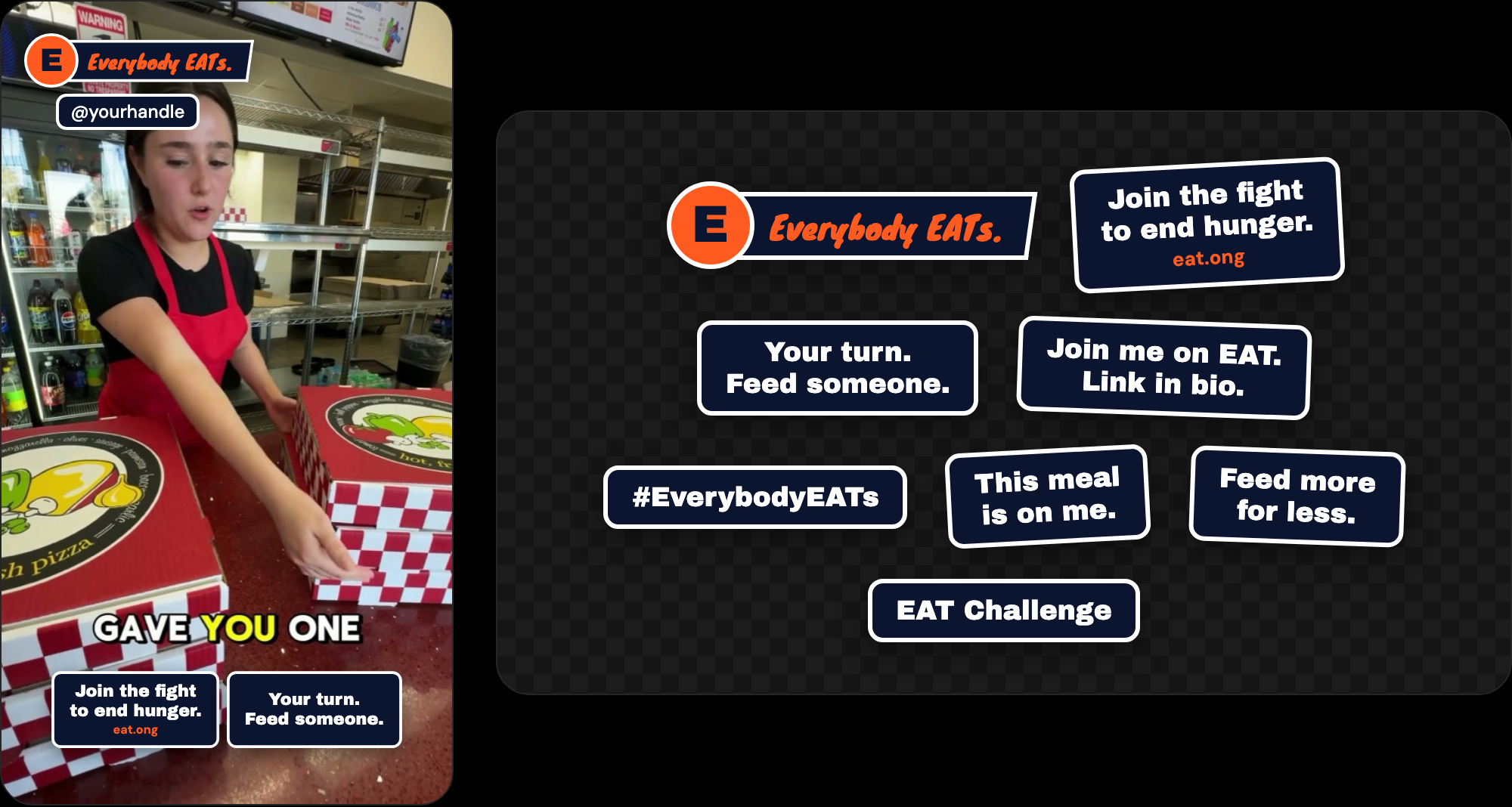
- Every EAT video carries one required sticker, "Everybody EATs.", in the top left. Creators can add up to two more along the bottom.
- The EAT Clipping Fund pays clippers $1 for every 1,000 verified views on approved clips. X's new clipping tool also lets clippers and creators earn from X, so a clip on X could be paid twice once X views count for the fund.
Apply to the $1M Clipping Fund →
WYDE Newsroom is part of the same ecosystem as EAT. This article covers our own network.
Most videos earn once, from the platform that hosts them. EAT is betting that a video about feeding people can earn many times: from the platform, from clips, from restaurants, from the network, and from the attention it brings back. Its creators and clippers now work from one idea, set out on fund.eat.ong: the most valuable content in the world is content that ends hunger.
This week the pieces of that idea lined up. EAT's creator app sorts every video into four levels. Every video wears the same sticker. And on November 9, Digital Trends reported that X now lets anyone clip a video inside the app, with both the clipper and the original creator able to earn. WYDE Newsroom covered X's clipping rules on November 12.
Why EAT says hunger content is worth the most
Hunger has one of the widest audiences of any topic. In the United States, 47.9 million people lived in food-insecure households in 2024, according to the USDA. A meal handed to a stranger needs no context, and EAT argues that is why the format travels.
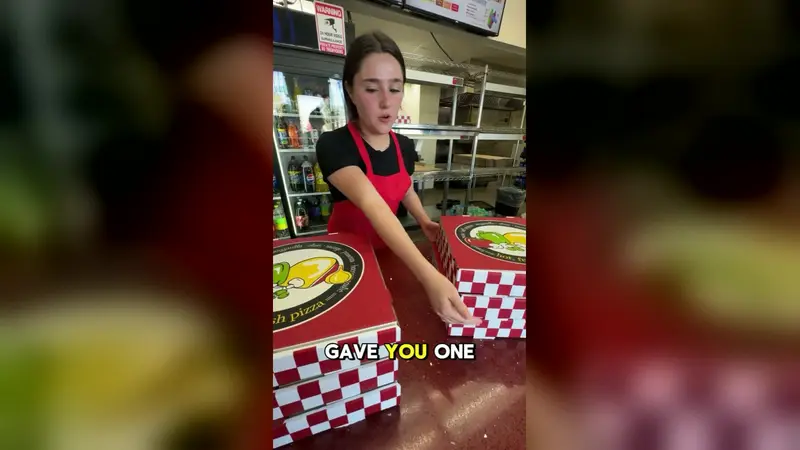
The clearest example is EAT's own. A creator asked a California pizzeria for 500 pizzas to give away. The restaurant said yes to six, and those six pizzas became a moment at a skatepark.
EAT's four video levels
EAT does not require a restaurant to start. Level 1 is the content a creator already makes.
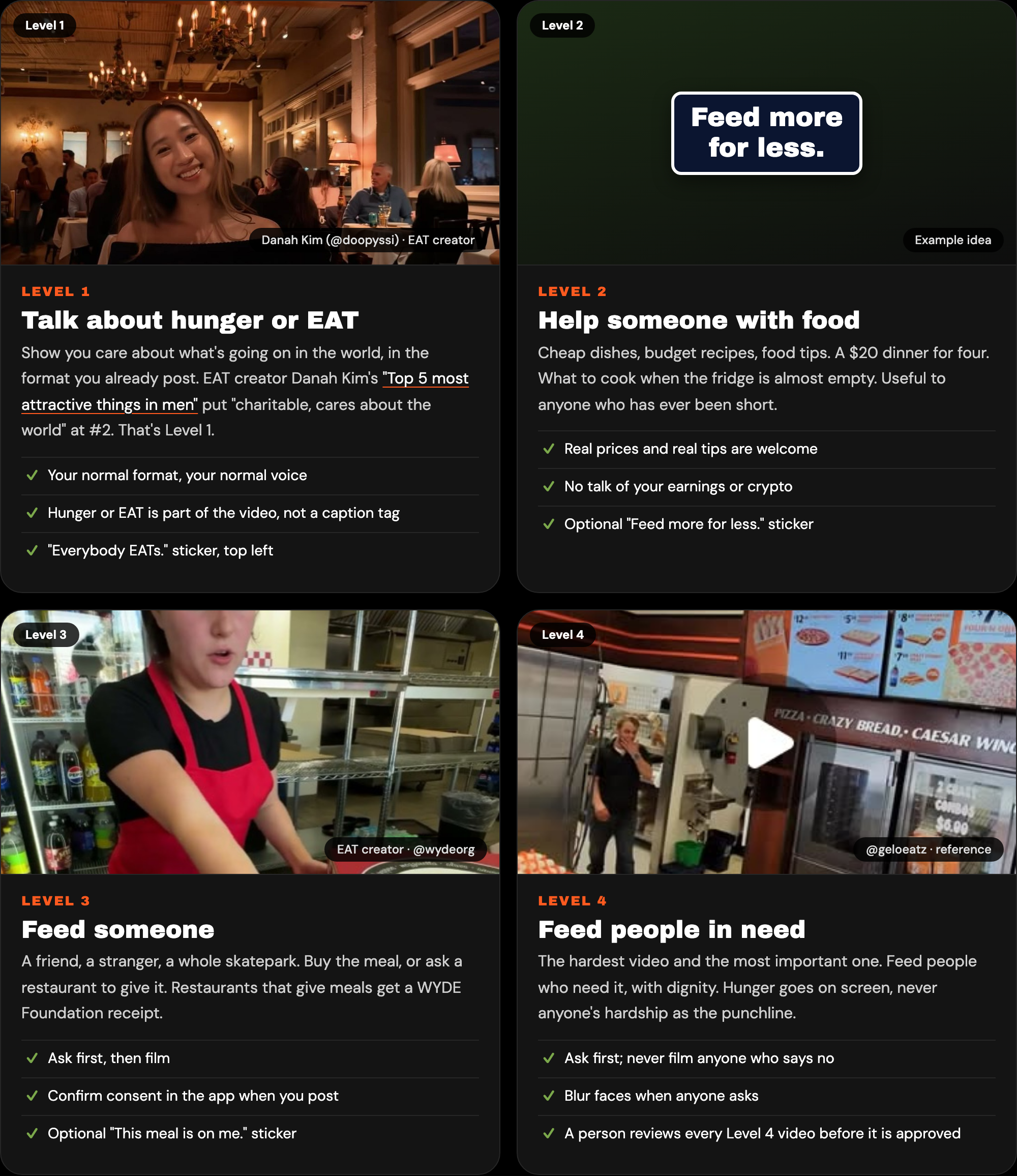
- Level 1, talk about hunger or EAT. Hunger awareness in a creator's normal format. Fund.eat.ong uses Danah Kim's "Top 5 most attractive things in men" as its example, where "charitable" sits at #2. Kim made the first video for the fund in October.
- Level 2, help someone with food. Cheap dishes, budget recipes and food tips.
- Level 3, feed someone. A friend, a stranger or a crowd, filmed only after they agree.
- Level 4, feed people in need. Filmed with dignity. Anyone who says no is never filmed, and a person reviews every Level 4 video before it is approved.
Fund.eat.ong lists what never qualifies: crypto price talk, gambling, adult content, reposts of other people's videos, and anything that mocks people in need.
One sticker on every video
Every EAT video carries "Everybody EATs." in the top left, with the creator's handle under it. Creators can add up to two optional stickers, side by side along the bottom: "Join the fight to end hunger.", "Your turn. Feed someone.", "Join me on EAT. Link in bio.", "#EverybodyEATs", "This meal is on me.", "Feed more for less." and "EAT Challenge".
How the EAT Clipping Fund pays clippers
Clippers cut 15 to 45 seconds from a video in EAT's clip library, add the EAT frame, and post it on their own accounts with eat.ong/@creator in the caption. EAT reads the views from the platform every day for 30 days. The fund pays $1 for every 1,000 verified views on approved clips, so its $1 million covers up to 1 billion views. Sign-ups and referrals never earn anything.
How a clip on X could be paid twice
X's clipping tool lets a user tap Repost, choose Clip video and post a 5 to 60 second clip of a pre-recorded video that is at least two minutes long. A clip cannot exceed 30% of the source, so a video of 3 minutes and 20 seconds is the shortest that allows a full 60 seconds. Every clip credits the original creator, and Digital Trends reports that both the clipper and the creator can earn from it. Neither Digital Trends nor ContentGrip gives a payout rate.
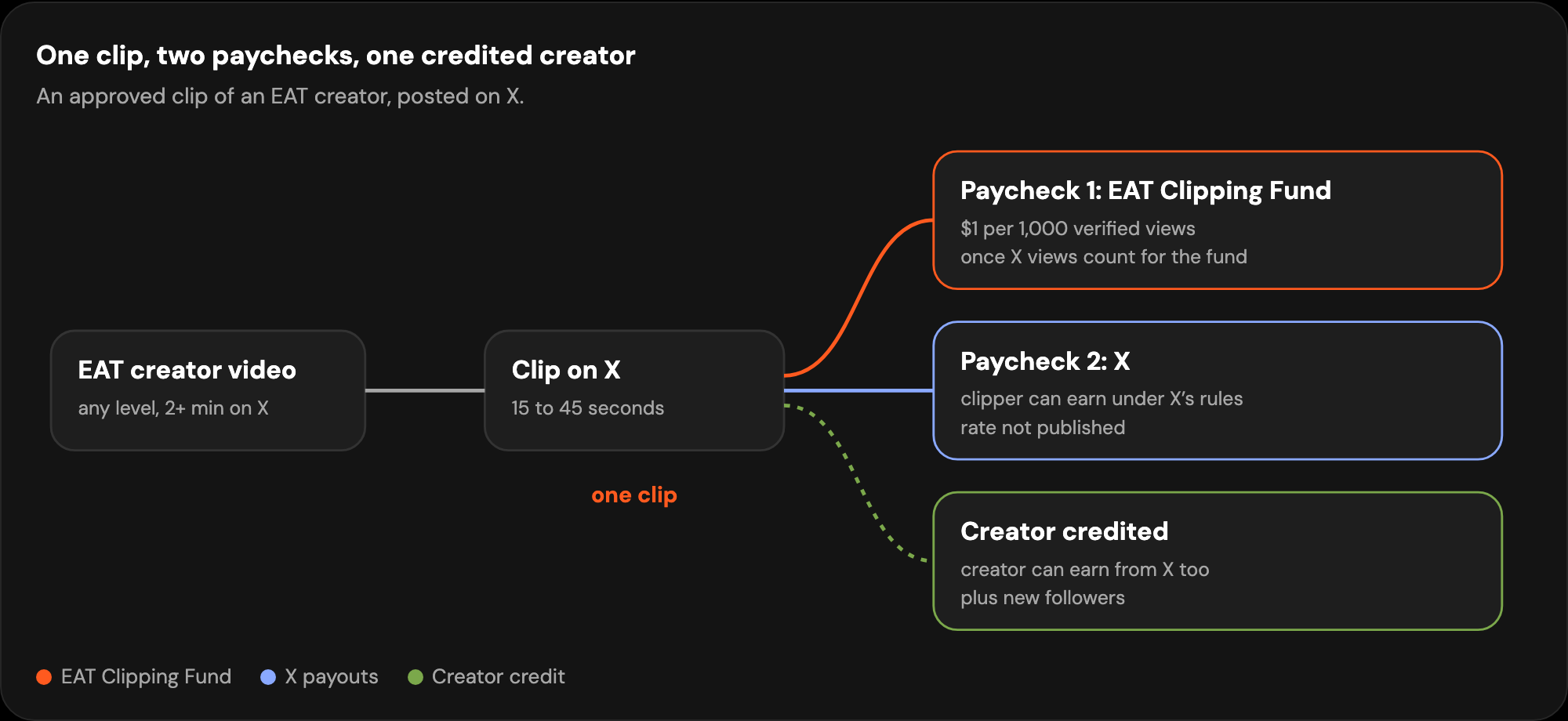
An EAT clip of 15 to 45 seconds fits inside X's limits. The timing matters, though. Creators.eat.ong says the fund counts TikTok and YouTube Shorts at launch, and Instagram Reels and X count once EAT can read their views. Until then, a clip on X earns from X, and the same cut on TikTok or Shorts earns from the fund.
What EAT adds for creators and clippers
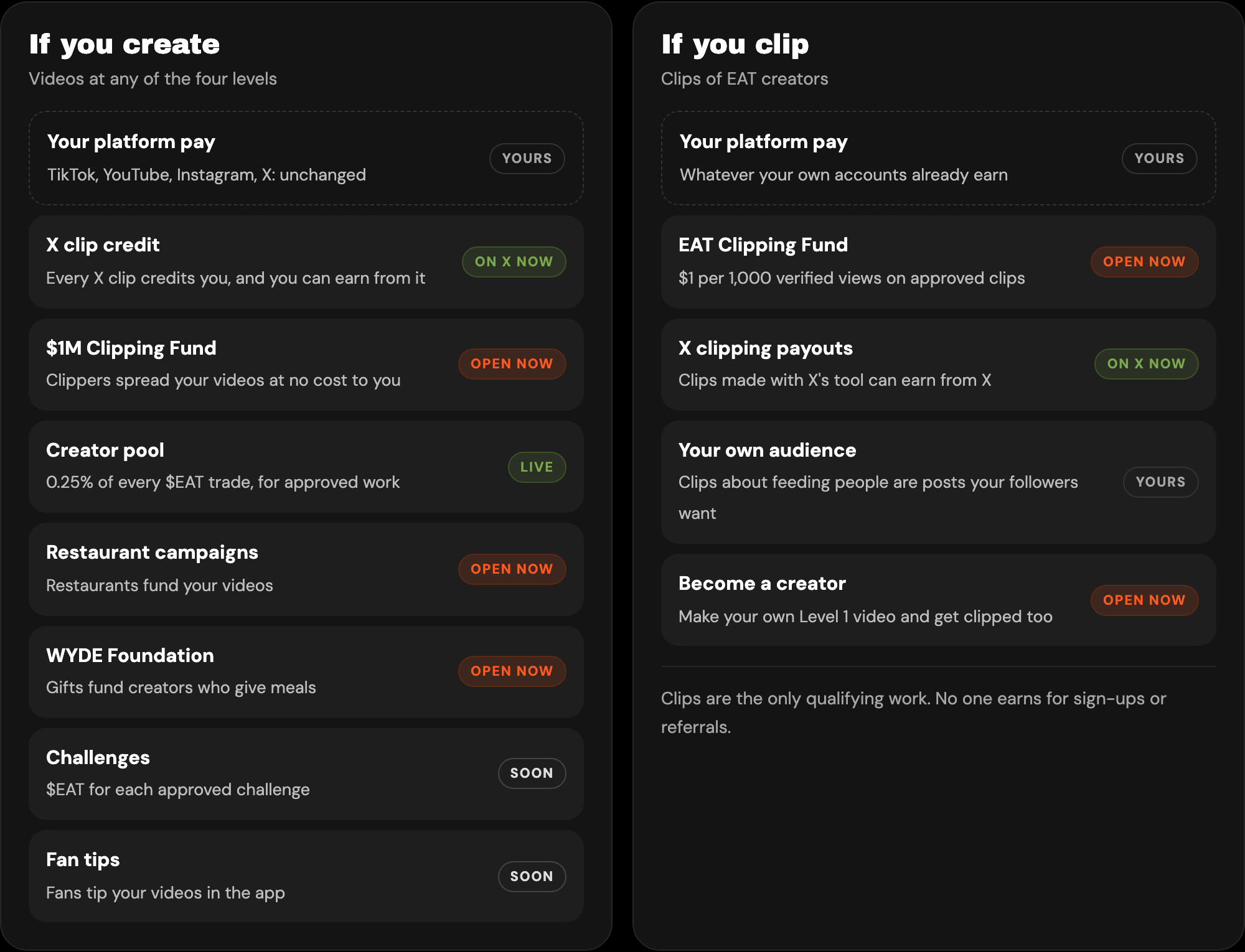
EAT frames its network as additional to what creators and clippers already earn. Eat.ong lists these ways creators get paid, with their status: the creator pool (0.25% of every $EAT trade, live), card fees for creator campaigns (live), restaurant campaigns (open now), WYDE Foundation gifts to creators who give meals (open now), the $1M Clipping Fund (open now), challenges (opening soon) and fan tips (opening soon).
How the money behind the meals moves
Clips do not fund meals on their own. EAT describes two separate paths. Meals are funded by $EAT trading: each trade carries a 1% fee, and 0.25% goes to hunger relief, counted at $1 = 5 meals, half to Feed the Children and half to a pool the community votes on. Eat.ong shows 74,255 meals funded by trades so far. Meals are also served on camera: a restaurant gives meals, a creator hands them out, and the restaurant can claim a WYDE Foundation receipt.
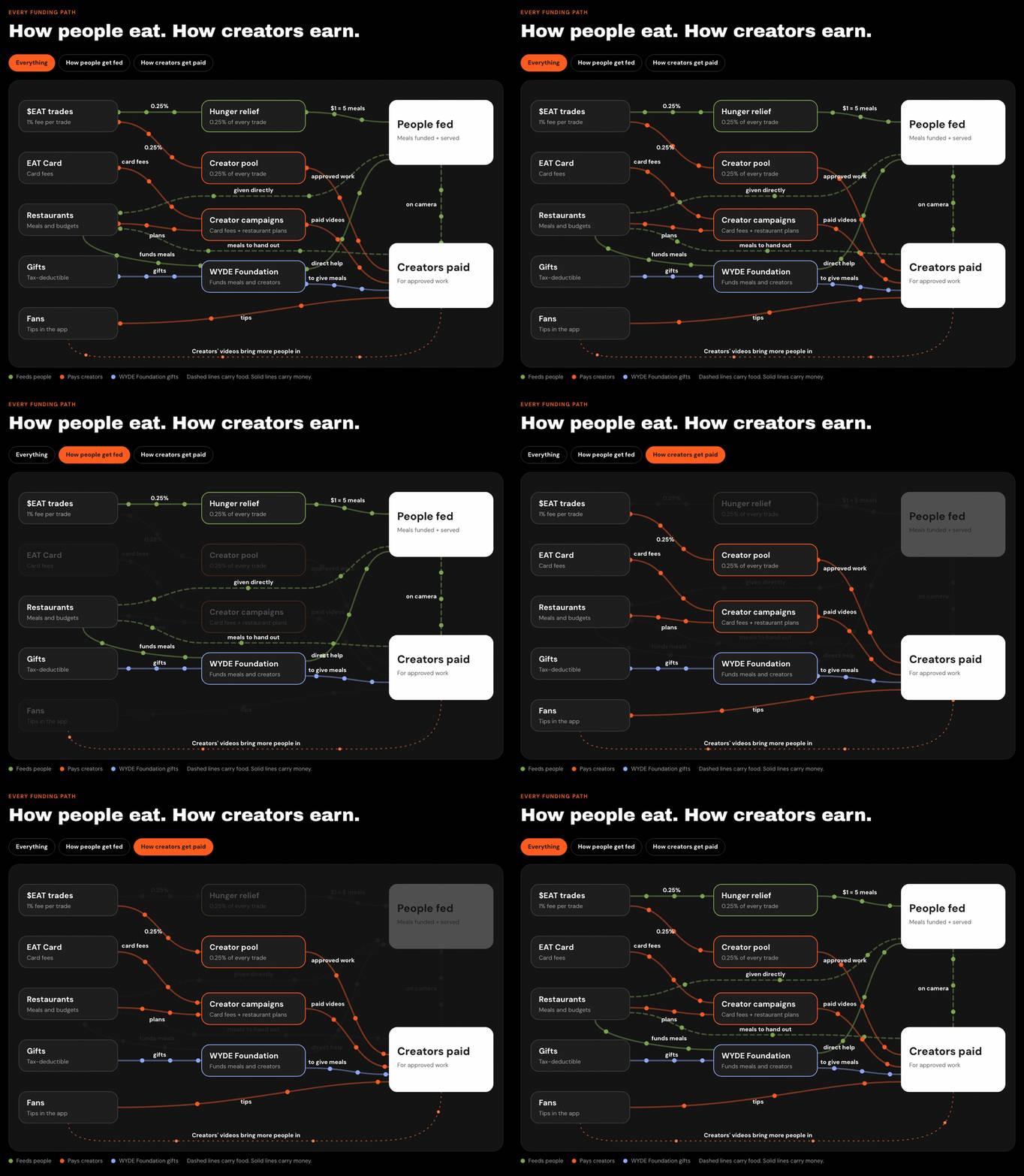
EAT does not promise earnings, views, followers or meals. No one needs to buy $EAT to create or clip. Restaurants that donate meals to an EAT creator can claim a food donation receipt from the WYDE Foundation, a 501(c)(3) public charity, at foundation.wyde.org/receipt.
People Also Ask
How do you get paid to clip videos for EAT?
Join at creators.eat.ong, pick a video from EAT's clip library, post a 15 to 45 second clip with the EAT frame on your own account, and send the link. The EAT Clipping Fund pays $1 for every 1,000 verified views on approved clips.
Can you get paid twice for clipping on X?
Possibly. X reports that clips made with its tool can earn for both the clipper and the creator, and the EAT Clipping Fund pays for clips of EAT creators. X views count for the fund once EAT can read them.
What are EAT's four video levels?
Level 1 is talking about hunger or EAT, Level 2 is helping someone with food, Level 3 is feeding someone, and Level 4 is feeding people in need, with a person reviewing every Level 4 video.
Sources: fund.eat.ong, creators.eat.ong, eat.ong/trade, Digital Trends, ContentGrip, USDA ERS.